Class 12- Applied Mathematics-NCERT Handbook Solutions-Unit-3(b)-Integration and its Applications

NCERT Handbook Solutions
Class 12-Applied Mathematics (Unit-3-b)

EXERCISE 3.1 (Integration and Its Application)

Q1
Evaluate the following:
(i) \( \int (x^2+1)(x-2)dx \)
(ii) \( \int (x+\frac{1}{x})^2 dx \)
(iii) \( \int \frac{x^3+x^2+x+1}{x+1} dx \)
(iv) \( \int \sqrt{3x+5}dx \)
(v) \( \int (x^2+\frac{1}{x^2})(x^2-\frac{1}{x^2}) dx \)
(vi) \( \int \frac{1}{\sqrt{x+4}-\sqrt{x-3}} dx \)

(i) \( \int (x^2+1)(x-2)dx \)

Expand the integrand:

\[ \int (x^3 - 2x^2 + x - 2) dx \] \[ = \frac{x^4}{4} - \frac{2x^3}{3} + \frac{x^2}{2} - 2x + C \]

(ii) \( \int (x+\frac{1}{x})^2 dx \)

Expand using \( (a+b)^2 \):

\[ \int (x^2 + 2 + \frac{1}{x^2}) dx = \int (x^2 + 2 + x^{-2}) dx \] \[ = \frac{x^3}{3} + 2x + \frac{x^{-1}}{-1} + C \] \[ = \frac{x^3}{3} + 2x - \frac{1}{x} + C \]

(iii) \( \int \frac{x^3+x^2+x+1}{x+1} dx \)

Factor the numerator by grouping:

\[ x^3+x^2+x+1 = x^2(x+1) + 1(x+1) = (x^2+1)(x+1) \]

Simplify the integral:

\[ \int \frac{(x^2+1)(x+1)}{x+1} dx = \int (x^2+1) dx \] \[ = \frac{x^3}{3} + x + C \]

(iv) \( \int \sqrt{3x+5}dx \)

Using the linear substitution rule \( \int (ax+b)^n dx = \frac{(ax+b)^{n+1}}{a(n+1)} \):

\[ = \frac{(3x+5)^{3/2}}{3 \cdot \frac{3}{2}} + C \] \[ = \frac{2}{9}(3x+5)^{3/2} + C \]

(v) \( \int (x^2+\frac{1}{x^2})(x^2-\frac{1}{x^2}) dx \)

Use \( (a+b)(a-b) = a^2 - b^2 \):

\[ \int (x^4 - \frac{1}{x^4}) dx = \int (x^4 - x^{-4}) dx \] \[ = \frac{x^5}{5} - \frac{x^{-3}}{-3} + C \] \[ = \frac{x^5}{5} + \frac{1}{3x^3} + C \]

(vi) \( \int \frac{1}{\sqrt{x+4}-\sqrt{x-3}} dx \)

Rationalize the denominator:

\[ \int \frac{\sqrt{x+4}+\sqrt{x-3}}{(\sqrt{x+4}-\sqrt{x-3})(\sqrt{x+4}+\sqrt{x-3})} dx \] \[ = \int \frac{\sqrt{x+4}+\sqrt{x-3}}{(x+4)-(x-3)} dx = \int \frac{\sqrt{x+4}+\sqrt{x-3}}{7} dx \] \[ = \frac{1}{7} \left[ \frac{(x+4)^{3/2}}{3/2} + \frac{(x-3)^{3/2}}{3/2} \right] + C \] \[ = \frac{2}{21} \left[ (x+4)^{3/2} + (x-3)^{3/2} \right] + C \]
Q2
Evaluate the following by substitution method:
(i) \( \int \frac{x+e^{2x}}{x^2+e^{2x}} dx \)    (ii) \( \int \frac{dx}{\sqrt{x}+x} \)
(iii) \( \int \frac{e^x(1+x)}{(1+xe^x)^2} dx \)    (iv) \( \int \frac{2x}{\sqrt[3]{x^2+1}} dx \)
(v) \( \int \frac{e^{2x}+e^{-2x}}{e^{2x}-e^{-2x}} dx \)    (vi) \( \int \frac{3e^x-5e^{-x}}{4e^x+5e^{-x}} dx \)
(vii) \( \int \frac{2x-3}{x^2-3x-18} dx \)    (viii) \( \int \frac{1}{x(1+\log x)^2} dx \)
(ix) \( \int \frac{a^{x-1}\cdot\log a + x^{a-1}}{a^x+x^a} dx \)

(i) \( \int \frac{x+e^{2x}}{x^2+e^{2x}} dx \)

Let \( t = x^2 + e^{2x} \). Then \( dt = (2x + 2e^{2x})dx = 2(x+e^{2x})dx \).

So, \( (x+e^{2x})dx = \frac{dt}{2} \).

\[ \int \frac{1}{t} \cdot \frac{dt}{2} = \frac{1}{2} \log|t| + C \] \[ = \frac{1}{2} \log|x^2+e^{2x}| + C \]

(ii) \( \int \frac{dx}{\sqrt{x}+x} \)

Rewrite as \( \int \frac{dx}{\sqrt{x}(1+\sqrt{x})} \).

Let \( t = 1 + \sqrt{x} \). Then \( dt = \frac{1}{2\sqrt{x}} dx \), so \( \frac{dx}{\sqrt{x}} = 2dt \).

\[ \int \frac{2dt}{t} = 2 \log|t| + C \] \[ = 2 \log|1+\sqrt{x}| + C \]

(iii) \( \int \frac{e^x(1+x)}{(1+xe^x)^2} dx \)

Let \( t = xe^x \). Then \( dt = (e^x \cdot 1 + x \cdot e^x)dx = e^x(1+x)dx \).

\[ \int \frac{dt}{(1+t)^2} = \int (1+t)^{-2} dt \] \[ = \frac{(1+t)^{-1}}{-1} + C = -\frac{1}{1+xe^x} + C \]

(iv) \( \int \frac{2x}{\sqrt[3]{x^2+1}} dx \)

Let \( t = x^2 + 1 \). Then \( dt = 2x dx \).

\[ \int \frac{dt}{t^{1/3}} = \int t^{-1/3} dt \] \[ = \frac{t^{2/3}}{2/3} + C = \frac{3}{2}(x^2+1)^{2/3} + C \]

(v) \( \int \frac{e^{2x}+e^{-2x}}{e^{2x}-e^{-2x}} dx \)

Let \( t = e^{2x} - e^{-2x} \). Then \( dt = (2e^{2x} + 2e^{-2x})dx = 2(e^{2x}+e^{-2x})dx \).

\[ \int \frac{1}{t} \cdot \frac{dt}{2} = \frac{1}{2} \log|e^{2x}-e^{-2x}| + C \]

(vi) \( \int \frac{3e^x-5e^{-x}}{4e^x+5e^{-x}} dx \)

Let \( N = 3e^x-5e^{-x} \) and \( D = 4e^x+5e^{-x} \).

Express \( N = A(D) + B(D') \), where \( D' = 4e^x-5e^{-x} \).

Comparing coefficients:

\[ 4A + 4B = 3 \] \[ 5A - 5B = -5 \Rightarrow A - B = -1 \]

Solving these gives \( A = -1/8 \) and \( B = 7/8 \).

\[ \text{Integral} = A x + B \log|D| + C \] \[ = -\frac{x}{8} + \frac{7}{8} \log|4e^x+5e^{-x}| + C \]

(vii) \( \int \frac{2x-3}{x^2-3x-18} dx \)

Let \( t = x^2-3x-18 \). \( dt = (2x-3)dx \).

\[ \int \frac{dt}{t} = \log|x^2-3x-18| + C \]

(viii) \( \int \frac{1}{x(1+\log x)^2} dx \)

Let \( t = 1 + \log x \). \( dt = \frac{1}{x} dx \).

\[ \int \frac{dt}{t^2} = -\frac{1}{t} + C = -\frac{1}{1+\log x} + C \]

(ix) \( \int \frac{a^{x-1}\cdot\log a + x^{a-1}}{a^x+x^a} dx \)

Let \( t = a^x + x^a \). Then \( dt = (a^x \log a + ax^{a-1})dx = a(a^{x-1}\log a + x^{a-1})dx \).

So, Numerator \( dx = \frac{dt}{a} \).

\[ \int \frac{1}{t} \frac{dt}{a} = \frac{1}{a} \log|a^x+x^a| + C \]
Q3
Find:
(i) \( \int \frac{1-2x}{\sqrt{1+x^2}} dx \)
(ii) \( \int \frac{1}{\sqrt{3x^2+2x-1}} dx \)

(i) \( \int \frac{1-2x}{\sqrt{1+x^2}} dx \)

Split the integral:

\[ I = \int \frac{1}{\sqrt{1+x^2}} dx - \int \frac{2x}{\sqrt{1+x^2}} dx \]

First part is a standard form: \( \log|x+\sqrt{1+x^2}| \).

Second part: Let \( t = 1+x^2, dt = 2x dx \). \( \int t^{-1/2} dt = 2t^{1/2} = 2\sqrt{1+x^2} \).

\[ I = \log|x+\sqrt{1+x^2}| - 2\sqrt{1+x^2} + C \]

(ii) \( \int \frac{1}{\sqrt{3x^2+2x-1}} dx \)

Factor out \( \sqrt{3} \):

\[ \frac{1}{\sqrt{3}} \int \frac{dx}{\sqrt{x^2 + \frac{2}{3}x - \frac{1}{3}}} \]

Complete the square in the denominator:

\[ x^2 + \frac{2}{3}x - \frac{1}{3} = (x + \frac{1}{3})^2 - \frac{1}{9} - \frac{3}{9} = (x + \frac{1}{3})^2 - \left(\frac{2}{3}\right)^2 \]

Using the formula \( \int \frac{dx}{\sqrt{x^2-a^2}} = \log|x+\sqrt{x^2-a^2}| \):

\[ = \frac{1}{\sqrt{3}} \log \left| (x+\frac{1}{3}) + \sqrt{x^2+\frac{2}{3}x-\frac{1}{3}} \right| + C \]
Q4
If the marginal revenue function of a firm in the production of output is \( MR = 40 - 10x^2 \) where x is the level of output and total revenue is ₹ 120 at 3 units of output, find the total revenue function.

Answer: \( R(x) = 40x - \frac{10}{3}x^3 + 90 \)

Total Revenue \( R(x) \) is the integral of Marginal Revenue.

\[ R(x) = \int (40 - 10x^2) dx = 40x - \frac{10x^3}{3} + C \]

Given \( R = 120 \) when \( x = 3 \):

\[ 120 = 40(3) - \frac{10(3)^3}{3} + C \] \[ 120 = 120 - 90 + C \] \[ 120 = 30 + C \Rightarrow C = 90 \]

Thus, \( R(x) = 40x - \frac{10}{3}x^3 + 90 \).

Q5
The marginal cost function of producing x units of a product is given by \( MC = \frac{x}{\sqrt{2500+x^2}} \). Find the total cost function and the average cost function, if the fixed cost is ₹ 1000.

Answer: \( C(x) = \sqrt{2500+x^2} + 950 \); \( AC(x) = \frac{\sqrt{2500+x^2} + 950}{x} \)

Total Cost Function \( C(x) \):

\[ C(x) = \int \frac{x}{\sqrt{2500+x^2}} dx \]

Let \( t = 2500 + x^2, dt = 2x dx \). \( \int \frac{dt/2}{\sqrt{t}} = \sqrt{t} \).

\[ C(x) = \sqrt{2500+x^2} + K \]

Fixed cost is the cost when output \( x=0 \). Given \( FC = 1000 \).

\[ C(0) = \sqrt{2500} + K = 50 + K \] \[ 1000 = 50 + K \Rightarrow K = 950 \] \[ C(x) = \sqrt{2500+x^2} + 950 \]

Average Cost Function \( AC(x) \):

\[ AC(x) = \frac{C(x)}{x} = \frac{\sqrt{2500+x^2} + 950}{x} \]
Q6
The marginal cost of producing x units of a product is given by \( MC = x\sqrt{x+1} \). The cost of producing 3 units is ₹ 7800. Find the cost function.

Answer: \( C(x) = \frac{2}{5}(x+1)^{5/2} - \frac{2}{3}(x+1)^{3/2} + 7792.53 \)

Cost Function:

\[ C(x) = \int x\sqrt{x+1} dx \]

Let \( u = x+1 \Rightarrow x = u-1, dx = du \).

\[ \int (u-1)u^{1/2} du = \int (u^{3/2} - u^{1/2}) du \] \[ = \frac{2}{5}u^{5/2} - \frac{2}{3}u^{3/2} + K \] \[ C(x) = \frac{2}{5}(x+1)^{5/2} - \frac{2}{3}(x+1)^{3/2} + K \]

Given \( C(3) = 7800 \):

\[ 7800 = \frac{2}{5}(4)^{5/2} - \frac{2}{3}(4)^{3/2} + K \] \[ 7800 = \frac{2}{5}(32) - \frac{2}{3}(8) + K \] \[ 7800 = 12.8 - 5.33 + K \Rightarrow 7800 = 7.47 + K \] \[ K \approx 7792.53 \] \[ C(x) = \frac{2}{5}(x+1)^{5/2} - \frac{2}{3}(x+1)^{3/2} + 7792.53 \]

EXERCISE 3.2

Q1
Integrate the following expressions:
(i) \( \frac{x+1}{(x+2)(x+4)} \)    (ii) \( \frac{x}{(x^2+1)(x^2+2)} \)
(iii) \( \frac{1}{e^{2x}-1} \)    (iv) \( \frac{1}{x((\log x)^2 - 3\log x + 2)} \)
(v) \( \frac{3x-2}{(x-2)^2(x+2)} \)    (vi) \( \frac{1}{e^{2x} + e^x} \)
(vii) \( \frac{5x+4}{(x^2-1)(x+2)} \)    (viii) \( \frac{x}{(x-1)^2(x+2)} \)
(ix) \( \frac{1}{x(x^4-1)} \)    (x) \( \frac{1}{x(x^n+1)} \)
(xi) \( \frac{1-x}{x(1-2x)} \)

(i) \( \int \frac{x+1}{(x+2)(x+4)} dx \)

Using partial fractions:

\[ \frac{x+1}{(x+2)(x+4)} = \frac{A}{x+2} + \frac{B}{x+4} \] \[ x+1 = A(x+4) + B(x+2) \]

At \( x = -2 \): \( -1 = 2A \Rightarrow A = -\frac{1}{2} \).

At \( x = -4 \): \( -3 = -2B \Rightarrow B = \frac{3}{2} \).

\[ \text{Integral} = -\frac{1}{2}\log|x+2| + \frac{3}{2}\log|x+4| + C \]

(ii) \( \int \frac{x}{(x^2+1)(x^2+2)} dx \)

Let \( x^2 = t \), then \( 2x dx = dt \Rightarrow x dx = \frac{dt}{2} \).

\[ \frac{1}{2} \int \frac{dt}{(t+1)(t+2)} = \frac{1}{2} \int \left( \frac{1}{t+1} - \frac{1}{t+2} \right) dt \] \[ = \frac{1}{2} [\log|t+1| - \log|t+2|] + C \] \[ = \frac{1}{2} \log\left| \frac{x^2+1}{x^2+2} \right| + C \]

(iii) \( \int \frac{1}{e^{2x}-1} dx \)

Let \( e^x = t \), \( e^x dx = dt \Rightarrow dx = \frac{dt}{t} \).

\[ \int \frac{1}{t^2-1} \cdot \frac{dt}{t} = \int \frac{1}{t(t-1)(t+1)} dt \]

Partial fractions: \( \frac{1}{t(t^2-1)} = -\frac{1}{t} + \frac{1}{2(t-1)} + \frac{1}{2(t+1)} \).

\[ \text{Integral} = -\log|t| + \frac{1}{2}\log|t-1| + \frac{1}{2}\log|t+1| + C \] \[ = -x + \frac{1}{2}\log|e^{2x}-1| + C \]

(iv) \( \int \frac{1}{x((\log x)^2 - 3\log x + 2)} dx \)

Let \( \log x = t \), \( \frac{1}{x} dx = dt \).

\[ \int \frac{dt}{t^2-3t+2} = \int \frac{dt}{(t-1)(t-2)} \] \[ = \int \left( \frac{1}{t-2} - \frac{1}{t-1} \right) dt = \log|t-2| - \log|t-1| + C \] \[ = \log\left| \frac{\log x - 2}{\log x - 1} \right| + C \]

(v) \( \int \frac{3x-2}{(x-2)^2(x+2)} dx \)

Form: \( \frac{A}{x-2} + \frac{B}{(x-2)^2} + \frac{C}{x+2} \).

Solving gives \( A = \frac{11}{32} \), \( B = 1 \), \( C = -\frac{11}{32} \). (Wait, let's recheck quickly: \( x=2 \Rightarrow 4 = 4B \Rightarrow B=1 \). \( x=-2 \Rightarrow -8 = 16C \Rightarrow C=-1/2 \). \( A+C=0 \Rightarrow A=1/2 \). Correct values: \( A=1/2, B=1, C=-1/2 \)).

\[ \text{Integral} = \frac{1}{2}\log|x-2| - \frac{1}{x-2} - \frac{1}{2}\log|x+2| + C \]

(vi) \( \int \frac{1}{e^{2x} + e^x} dx \)

Let \( e^x = t \), \( dx = \frac{dt}{t} \).

\[ \int \frac{1}{t^2+t} \frac{dt}{t} \text{ (Incorrect sub step, correction: } \int \frac{1}{t(t+1)} \frac{dt}{t} \text{? No)} \]

Correction: \( \int \frac{1}{e^x(e^x+1)} dx \). Let \( e^x=t \), \( dx=dt/t \). Integral is \( \int \frac{1}{t^2(t+1)} dt \).

Partial fractions on \( \frac{1}{t^2(t+1)} = -\frac{1}{t} + \frac{1}{t^2} + \frac{1}{t+1} \).

\[ = -\log|t| - \frac{1}{t} + \log|t+1| + C \] \[ = \log(e^x+1) - x - e^{-x} + C \]

Alternative approach: \( \int \frac{e^{-2x}}{1+e^{-x}} dx \). Or simple partial fractions.


(vii) \( \int \frac{5x+4}{(x^2-1)(x+2)} dx \)

Factor denominator: \( (x-1)(x+1)(x+2) \).

\[ \frac{5x+4}{(x-1)(x+1)(x+2)} = \frac{A}{x-1} + \frac{B}{x+1} + \frac{C}{x+2} \]

\( A = 3/2 \), \( B = 1/2 \), \( C = -2 \).

\[ = \frac{3}{2}\log|x-1| + \frac{1}{2}\log|x+1| - 2\log|x+2| + C \]

(viii) \( \int \frac{x}{(x-1)^2(x+2)} dx \)

\( A/(x-1) + B/(x-1)^2 + C/(x+2) \).

\( B = 1/3 \), \( C = -2/9 \), \( A = 2/9 \).

\[ = \frac{2}{9}\log|x-1| - \frac{1}{3(x-1)} - \frac{2}{9}\log|x+2| + C \]

(ix) \( \int \frac{1}{x(x^4-1)} dx \)

Multiply numerator and denominator by \( x^3 \): \( \int \frac{x^3}{x^4(x^4-1)} dx \).

Let \( x^4 = t \), \( 4x^3 dx = dt \).

\[ \frac{1}{4} \int \frac{dt}{t(t-1)} = \frac{1}{4} (\log|t-1| - \log|t|) + C \] \[ = \frac{1}{4} \log\left| \frac{x^4-1}{x^4} \right| + C \]

(x) \( \int \frac{1}{x(x^n+1)} dx \)

Similar to (ix), multiply by \( x^{n-1} \). Let \( x^n = t \).

\[ = \frac{1}{n} \log\left| \frac{x^n}{x^n+1} \right| + C \]

(xi) \( \int \frac{1-x}{x(1-2x)} dx \)

Partial fractions: \( \frac{1-x}{x(1-2x)} = \frac{A}{x} + \frac{B}{1-2x} \).

\( 1-x = A(1-2x) + Bx \).

\( x=0 \Rightarrow A=1 \). \( x=1/2 \Rightarrow 1/2 = B/2 \Rightarrow B=1 \).

\[ \int \left( \frac{1}{x} + \frac{1}{1-2x} \right) dx = \log|x| - \frac{1}{2}\log|1-2x| + C \]
Q2
The marginal revenue function for a firm is given by \( \frac{5x^2+30x+51}{(x+3)^2} \).
Show that the revenue function is given by \( \frac{2x}{x+3} + 5x \).

Proof:

Revenue \( R(x) = \int MR(x) dx \).

\[ MR(x) = \frac{5x^2+30x+51}{(x+3)^2} = \frac{5(x^2+6x+9) + 6}{(x+3)^2} \] \[ = \frac{5(x+3)^2 + 6}{(x+3)^2} = 5 + \frac{6}{(x+3)^2} \]

Integrate w.r.t \( x \):

\[ R(x) = \int \left( 5 + 6(x+3)^{-2} \right) dx = 5x + 6 \frac{(x+3)^{-1}}{-1} + C \] \[ R(x) = 5x - \frac{6}{x+3} + C \]

When output \( x = 0 \), Revenue \( R = 0 \).

\[ 0 = 0 - \frac{6}{3} + C \Rightarrow -2 + C = 0 \Rightarrow C = 2 \]

So, \( R(x) = 5x - \frac{6}{x+3} + 2 \).

To show it equals \( \frac{2x}{x+3} + 5x \), we simplify the constant part:

\[ 2 - \frac{6}{x+3} = \frac{2(x+3)-6}{x+3} = \frac{2x+6-6}{x+3} = \frac{2x}{x+3} \]

Thus, \( R(x) = 5x + \frac{2x}{x+3} \). Hence Proved.

Q3
Find the total revenue function and demand function, if the marginal revenue function is given by \[ MR(x) = \frac{ab}{(x+b)^2} - c \]

Answer:

1. Total Revenue Function \( R(x) \):

\[ R(x) = \int MR(x) dx = \int \left( ab(x+b)^{-2} - c \right) dx \] \[ = ab \frac{(x+b)^{-1}}{-1} - cx + K \] \[ = -\frac{ab}{x+b} - cx + K \]

At \( x=0, R=0 \):

\[ 0 = -\frac{ab}{b} - 0 + K \Rightarrow K = a \]

Substitute \( K \):

\[ R(x) = a - \frac{ab}{x+b} - cx = \frac{a(x+b) - ab}{x+b} - cx \] \[ R(x) = \frac{ax}{x+b} - cx \]

2. Demand Function \( p(x) \):

Demand function \( p = \frac{R(x)}{x} \).

\[ p = \frac{1}{x} \left( \frac{ax}{x+b} - cx \right) = \frac{a}{x+b} - c \]

EXERCISE 3.3

Q1
Integrate the following functions:
(i) \( x e^{2x+3} \)    (ii) \( x \log(x^2 + 1) \)
(iii) \( x^2 e^x \)    (iv) \( x \log x \)
(v) \( x \log 2x \)    (vi) \( x^2 \log x \)
(vii) \( (x^2 + 1) \log x \)    (viii) \( x (\log x)^2 \)

(i) \( \int x e^{2x+3} dx \)

Using integration by parts: \( \int u dv = uv - \int v du \).

Let \( u = x \Rightarrow du = dx \).

Let \( dv = e^{2x+3} dx \Rightarrow v = \frac{1}{2}e^{2x+3} \).

\[ I = \frac{x}{2}e^{2x+3} - \int \frac{1}{2}e^{2x+3} dx \] \[ I = \frac{x}{2}e^{2x+3} - \frac{1}{4}e^{2x+3} + C = \frac{e^{2x+3}}{4}(2x-1) + C \]

(ii) \( \int x \log(x^2 + 1) dx \)

Substitution: Let \( x^2 + 1 = t \Rightarrow 2x dx = dt \Rightarrow x dx = \frac{dt}{2} \).

\[ I = \frac{1}{2} \int \log t \, dt \]

Standard integral of \( \log t \) is \( t \log t - t \):

\[ I = \frac{1}{2} [t \log t - t] + C \] \[ I = \frac{1}{2} [(x^2+1)\log(x^2+1) - (x^2+1)] + C \]

(iii) \( \int x^2 e^x dx \)

Integration by parts twice.

1st: \( u = x^2, dv = e^x dx \Rightarrow I = x^2 e^x - \int 2x e^x dx \).

2nd: For \( \int x e^x dx \), let \( u = x, dv = e^x dx \Rightarrow x e^x - e^x \).

\[ I = x^2 e^x - 2(x e^x - e^x) + C \] \[ I = e^x(x^2 - 2x + 2) + C \]

(iv) \( \int x \log x dx \)

Let \( u = \log x \) (ILATE rule), \( dv = x dx \).

\( du = \frac{1}{x} dx, v = \frac{x^2}{2} \).

\[ I = \frac{x^2}{2} \log x - \int \frac{x^2}{2} \cdot \frac{1}{x} dx \] \[ I = \frac{x^2}{2} \log x - \frac{1}{2} \int x dx \] \[ I = \frac{x^2}{2} \log x - \frac{x^2}{4} + C \]

(v) \( \int x \log 2x dx \)

Let \( u = \log 2x, dv = x dx \).

\( du = \frac{1}{2x} \cdot 2 dx = \frac{1}{x} dx, v = \frac{x^2}{2} \).

\[ I = \frac{x^2}{2} \log 2x - \int \frac{x^2}{2} \cdot \frac{1}{x} dx \] \[ I = \frac{x^2}{2} \log 2x - \frac{x^2}{4} + C \]

(vi) \( \int x^2 \log x dx \)

Let \( u = \log x, dv = x^2 dx \).

\( du = \frac{1}{x} dx, v = \frac{x^3}{3} \).

\[ I = \frac{x^3}{3} \log x - \int \frac{x^3}{3} \cdot \frac{1}{x} dx \] \[ I = \frac{x^3}{3} \log x - \frac{1}{3} \int x^2 dx \] \[ I = \frac{x^3}{3} \log x - \frac{x^3}{9} + C \]

(vii) \( \int (x^2 + 1) \log x dx \)

Split into \( \int x^2 \log x dx + \int \log x dx \).

From (vi): \( \int x^2 \log x dx = \frac{x^3}{3}\log x - \frac{x^3}{9} \).

Standard integral: \( \int \log x dx = x \log x - x \).

\[ I = \frac{x^3}{3}\log x - \frac{x^3}{9} + x \log x - x + C \] \[ I = \left(\frac{x^3}{3} + x\right)\log x - \left(\frac{x^3}{9} + x\right) + C \]

(viii) \( \int x (\log x)^2 dx \)

Let \( u = (\log x)^2, dv = x dx \).

\( du = 2 \log x \cdot \frac{1}{x} dx, v = \frac{x^2}{2} \).

\[ I = \frac{x^2}{2}(\log x)^2 - \int \frac{x^2}{2} \cdot \frac{2 \log x}{x} dx \] \[ I = \frac{x^2}{2}(\log x)^2 - \int x \log x dx \]

Using result from (iv):

\[ I = \frac{x^2}{2}(\log x)^2 - \left( \frac{x^2}{2} \log x - \frac{x^2}{4} \right) + C \]
Q2
Evaluate the following:
(i) \( \int e^x [x^{-2} - 2x^{-3}] dx \)
(ii) \( \int e^{3x} [\log 3x + \frac{1}{3x}] dx \)
(iii) \( \int e^{2x} [\frac{2x-1}{4x^2}] dx \)
(iv) \( \int [\log(\log x) + \frac{1}{(\log x)^2}] dx \)

(i) \( \int e^x [x^{-2} - 2x^{-3}] dx \)

Using the property \( \int e^x [f(x) + f'(x)] dx = e^x f(x) + C \).

Let \( f(x) = x^{-2} \). Then \( f'(x) = -2x^{-3} \).

This matches the integrand exactly.

\[ I = e^x x^{-2} + C = \frac{e^x}{x^2} + C \]

(ii) \( \int e^{3x} [\log 3x + \frac{1}{3x}] dx \)

Let \( 3x = t \Rightarrow 3dx = dt \). Integral becomes \( \frac{1}{3} \int e^t [\log t + \frac{1}{t}] dt \).

Here \( f(t) = \log t \) and \( f'(t) = \frac{1}{t} \).

\[ I = \frac{1}{3} e^t \log t + C = \frac{1}{3} e^{3x} \log 3x + C \]

(iii) \( \int e^{2x} [\frac{2x-1}{4x^2}] dx \)

Simplify term inside bracket: \( \frac{2x}{4x^2} - \frac{1}{4x^2} = \frac{1}{2x} - \frac{1}{4x^2} \).

Let \( 2x = t \). Then \( \frac{1}{2x} = \frac{1}{t} \) and \( \frac{1}{4x^2} = \frac{1}{t^2} \). Also \( dx = \frac{dt}{2} \).

\[ I = \int e^t \left[ \frac{1}{t} - \frac{1}{t^2} \right] \frac{dt}{2} \]

Using \( f(t) = \frac{1}{t}, f'(t) = -\frac{1}{t^2} \):

\[ I = \frac{1}{2} e^t \left(\frac{1}{t}\right) + C = \frac{e^{2x}}{2(2x)} + C = \frac{e^{2x}}{4x} + C \]

(iv) \( \int [\log(\log x) + \frac{1}{(\log x)^2}] dx \)

Let \( \log x = t \Rightarrow x = e^t \Rightarrow dx = e^t dt \).

\[ I = \int \left[ \log t + \frac{1}{t^2} \right] e^t dt \]

Add and subtract \( \frac{1}{t} \):

\[ I = \int e^t \left[ \left(\log t + \frac{1}{t}\right) - \left(\frac{1}{t} - \frac{1}{t^2}\right) \right] dt \]

First part: \( f(t) = \log t, f'(t) = 1/t \Rightarrow e^t \log t \).

Second part: \( g(t) = 1/t, g'(t) = -1/t^2 \Rightarrow e^t (1/t) \).

\[ I = e^t \log t - \frac{e^t}{t} + C \] \[ I = x \log(\log x) - \frac{x}{\log x} + C \]

EXERCISE 3.4

Q1
Evaluate: \( \int_{e}^{e^2} \frac{1}{x \log x} dx \)

Answer: \( \log 2 \)

Let \( \log x = t \). Then \( \frac{1}{x} dx = dt \).

Limits:

  • When \( x = e, t = \log e = 1 \).
  • When \( x = e^2, t = \log e^2 = 2 \).
\[ I = \int_{1}^{2} \frac{1}{t} dt \] \[ I = [\log t]_{1}^{2} = \log 2 - \log 1 \] \[ I = \log 2 \]
Q2
Evaluate: \( \int_{1}^{2} e^{-\log x} dx \)

Answer: \( \log 2 \)

Simplify the integrand:

\[ e^{-\log x} = e^{\log(x^{-1})} = x^{-1} = \frac{1}{x} \] \[ I = \int_{1}^{2} \frac{1}{x} dx \] \[ I = [\log x]_{1}^{2} = \log 2 - \log 1 \] \[ I = \log 2 \]
Q3
Evaluate: \( \int_{\log 2}^{\log 4} 2^x dx \)

Answer: \( \frac{2^{\log 4} - 2^{\log 2}}{\log 2} \)

Integration formula: \( \int a^x dx = \frac{a^x}{\log a} \).

\[ I = \left[ \frac{2^x}{\log 2} \right]_{\log 2}^{\log 4} \] \[ I = \frac{1}{\log 2} (2^{\log 4} - 2^{\log 2}) \]

Note: Assuming base \( e \) for log, this is the final form. If limits were base 2 (\( \log_2 \)), it would simplify further to \( \frac{4-2}{\log 2} \).

Q4
Evaluate: \( \int_{0}^{\sqrt{3}} \frac{x}{(16-x^4)} dx \)

Answer: \( \frac{1}{16} \log 7 \)

Let \( x^2 = t \). Then \( 2x dx = dt \Rightarrow x dx = \frac{dt}{2} \).

Limits:

  • When \( x = 0, t = 0 \).
  • When \( x = \sqrt{3}, t = 3 \).
\[ I = \frac{1}{2} \int_{0}^{3} \frac{dt}{16 - t^2} = \frac{1}{2} \int_{0}^{3} \frac{dt}{4^2 - t^2} \]

Using \( \int \frac{dx}{a^2-x^2} = \frac{1}{2a} \log \left| \frac{a+x}{a-x} \right| \):

\[ I = \frac{1}{2} \left[ \frac{1}{2(4)} \log \left| \frac{4+t}{4-t} \right| \right]_{0}^{3} \] \[ I = \frac{1}{16} \left[ \log \left| \frac{4+3}{4-3} \right| - \log \left| \frac{4+0}{4-0} \right| \right] \] \[ I = \frac{1}{16} (\log 7 - \log 1) = \frac{\log 7}{16} \]
Q5
Evaluate: \( \int_{0}^{1} \frac{1}{\sqrt{x+1}-\sqrt{x}} dx \)

Answer: \( \frac{2}{3}(2\sqrt{2}) \) or \( \frac{4\sqrt{2}}{3} \)

Rationalize the denominator:

\[ \frac{1}{\sqrt{x+1}-\sqrt{x}} \times \frac{\sqrt{x+1}+\sqrt{x}}{\sqrt{x+1}+\sqrt{x}} = \frac{\sqrt{x+1}+\sqrt{x}}{(x+1)-x} = \sqrt{x+1}+\sqrt{x} \] \[ I = \int_{0}^{1} (x+1)^{1/2} dx + \int_{0}^{1} x^{1/2} dx \] \[ I = \left[ \frac{2}{3}(x+1)^{3/2} \right]_{0}^{1} + \left[ \frac{2}{3}x^{3/2} \right]_{0}^{1} \] \[ I = \frac{2}{3} [ (2)^{3/2} - (1)^{3/2} ] + \frac{2}{3} [ 1 - 0 ] \] \[ I = \frac{2}{3} (2\sqrt{2} - 1) + \frac{2}{3} \] \[ I = \frac{4\sqrt{2}}{3} - \frac{2}{3} + \frac{2}{3} = \frac{4\sqrt{2}}{3} \]
Q6
Evaluate: \( \int_{0}^{1} e^x \sqrt{1+e^x} dx \)

Answer: \( \frac{2}{3} ( (1+e)^{3/2} - 2\sqrt{2} ) \)

Let \( 1+e^x = t \). Then \( e^x dx = dt \).

Limits:

  • When \( x = 0, t = 1+1 = 2 \).
  • When \( x = 1, t = 1+e \).
\[ I = \int_{2}^{1+e} \sqrt{t} dt = \int_{2}^{1+e} t^{1/2} dt \] \[ I = \left[ \frac{2}{3} t^{3/2} \right]_{2}^{1+e} \] \[ I = \frac{2}{3} \left[ (1+e)^{3/2} - 2^{3/2} \right] \] \[ I = \frac{2}{3} \left[ (1+e)^{3/2} - 2\sqrt{2} \right] \]
Q7
Evaluate: \( \int_{4}^{5} \frac{1}{\sqrt{x^2-16}} dx \)

Answer: \( \log 2 \)

Formula: \( \int \frac{dx}{\sqrt{x^2-a^2}} = \log |x + \sqrt{x^2-a^2}| \).

\[ I = \left[ \log |x + \sqrt{x^2-16}| \right]_{4}^{5} \] \[ I = \log |5 + \sqrt{25-16}| - \log |4 + \sqrt{16-16}| \] \[ I = \log |5 + 3| - \log |4 + 0| \] \[ I = \log 8 - \log 4 = \log \left(\frac{8}{4}\right) = \log 2 \]
Q8
Evaluate: \( \int_{0}^{1} \log(1+2x) dx \)

Answer: \( \frac{3}{2}\log 3 - 1 \)

Use integration by parts. Let \( u = \log(1+2x) \) and \( dv = dx \).

\( du = \frac{2}{1+2x} dx \) and \( v = x \).

Alternatively, substitute \( 1+2x = t \), \( dx = dt/2 \).

Using substitution: Limits \( 1 \to 3 \).

\[ I = \frac{1}{2} \int_{1}^{3} \log t dt \] \[ I = \frac{1}{2} [t \log t - t]_{1}^{3} \] \[ I = \frac{1}{2} [ (3 \log 3 - 3) - (1 \log 1 - 1) ] \] \[ I = \frac{1}{2} [ 3 \log 3 - 3 + 1 ] = \frac{1}{2} [ 3 \log 3 - 2 ] \] \[ I = \frac{3}{2} \log 3 - 1 \]
Q9
Evaluate: \( \int_{0}^{4} \sqrt{x^2+9} dx \)

Answer: \( 10 + \frac{9}{2}\log 3 \)

Formula: \( \int \sqrt{x^2+a^2} dx = \frac{x}{2}\sqrt{x^2+a^2} + \frac{a^2}{2}\log|x+\sqrt{x^2+a^2}| \).

Here \( a = 3 \).

\[ I = \left[ \frac{x}{2}\sqrt{x^2+9} + \frac{9}{2}\log|x+\sqrt{x^2+9}| \right]_{0}^{4} \] \[ \text{Upper Limit (4): } \frac{4}{2}\sqrt{16+9} + \frac{9}{2}\log(4+\sqrt{25}) = 2(5) + \frac{9}{2}\log 9 = 10 + 9\log 3 \] \[ \text{Lower Limit (0): } 0 + \frac{9}{2}\log(0+\sqrt{9}) = \frac{9}{2}\log 3 \] \[ I = (10 + 9\log 3) - (\frac{9}{2}\log 3) \] \[ I = 10 + \frac{9}{2}\log 3 \]
Q10
Evaluate: \( \int_{0}^{1} \frac{3t^2}{(1+t^3)(2+t^3)} dt \)

Answer: \( \log(4/3) \)

Let \( t^3 = u \). Then \( 3t^2 dt = du \).

Limits:

  • When \( t=0, u=0 \).
  • When \( t=1, u=1 \).
\[ I = \int_{0}^{1} \frac{du}{(1+u)(2+u)} \]

Partial fractions: \( \frac{1}{(u+1)(u+2)} = \frac{1}{u+1} - \frac{1}{u+2} \).

\[ I = \int_{0}^{1} \left( \frac{1}{u+1} - \frac{1}{u+2} \right) du \] \[ I = [\log|u+1| - \log|u+2|]_{0}^{1} = \left[ \log \frac{u+1}{u+2} \right]_{0}^{1} \] \[ I = \log \frac{2}{3} - \log \frac{1}{2} = \log \frac{2}{3} - \log 0.5 \] \[ I = \log \left( \frac{2/3}{1/2} \right) = \log \left( \frac{4}{3} \right) \]

EXERCISE 3.5 (Deleted from Syllabus)

EXERCISE 3.6

Q1
If the demand function is \( p = 35 - 2x - x^2 \) and the demand \( x_0 \) is 3, find the consumers’ surplus.

Answer: 27

Given demand function: \( p = 35 - 2x - x^2 \).

At demand \( x_0 = 3 \), the price \( p_0 \) is:

\[ p_0 = 35 - 2(3) - (3)^2 = 35 - 6 - 9 = 20 \]

Consumers' Surplus (CS) is given by:

\[ CS = \int_{0}^{x_0} f(x) dx - p_0 x_0 \] \[ CS = \int_{0}^{3} (35 - 2x - x^2) dx - (20 \times 3) \] \[ = \left[ 35x - x^2 - \frac{x^3}{3} \right]_{0}^{3} - 60 \] \[ = \left[ 35(3) - (3)^2 - \frac{27}{3} \right] - 60 \] \[ = [105 - 9 - 9] - 60 \] \[ = 87 - 60 = 27 \]
Q2
If the demand function for a commodity is \( p = 25 - x^2 \), find the consumers’ surplus for \( p_0 = 9 \).

Answer: \( \frac{128}{3} \) (or 42.67)

Given \( p_0 = 9 \). We find the quantity \( x_0 \):

\[ 9 = 25 - x_0^2 \Rightarrow x_0^2 = 16 \Rightarrow x_0 = 4 \]

Consumers' Surplus (CS):

\[ CS = \int_{0}^{4} (25 - x^2) dx - p_0 x_0 \] \[ CS = \left[ 25x - \frac{x^3}{3} \right]_{0}^{4} - (9 \times 4) \] \[ = \left[ 25(4) - \frac{64}{3} \right] - 36 \] \[ = \left[ 100 - \frac{64}{3} \right] - 36 \] \[ = 64 - \frac{64}{3} = \frac{192 - 64}{3} = \frac{128}{3} \]
Q3
The demand function for a commodity is \( p = 10 - 2x \). Find the consumers’ surplus for (i) \( p = 2 \) (ii) \( p = 6 \).

(i) For \( p = 2 \):

Find \( x_0 \): \( 2 = 10 - 2x \Rightarrow 2x = 8 \Rightarrow x_0 = 4 \).

\[ CS = \int_{0}^{4} (10 - 2x) dx - (2 \times 4) \] \[ = \left[ 10x - x^2 \right]_{0}^{4} - 8 \] \[ = [40 - 16] - 8 = 24 - 8 = 16 \]

(ii) For \( p = 6 \):

Find \( x_0 \): \( 6 = 10 - 2x \Rightarrow 2x = 4 \Rightarrow x_0 = 2 \).

\[ CS = \int_{0}^{2} (10 - 2x) dx - (6 \times 2) \] \[ = \left[ 10x - x^2 \right]_{0}^{2} - 12 \] \[ = [20 - 4] - 12 = 16 - 12 = 4 \]
Q4
The demand function for a commodity is \( p = 80 - 3x - x^2 \). Find the consumers’ surplus for \( p = 40 \).

Answer: \( \frac{725}{6} \) (or 120.83)

Find \( x_0 \) when \( p = 40 \):

\[ 40 = 80 - 3x - x^2 \Rightarrow x^2 + 3x - 40 = 0 \] \[ (x + 8)(x - 5) = 0 \]

Since quantity cannot be negative, \( x_0 = 5 \).

Total Revenue \( p_0 x_0 = 40 \times 5 = 200 \).

\[ CS = \int_{0}^{5} (80 - 3x - x^2) dx - 200 \] \[ = \left[ 80x - \frac{3x^2}{2} - \frac{x^3}{3} \right]_{0}^{5} - 200 \] \[ = \left[ 400 - \frac{75}{2} - \frac{125}{3} \right] - 200 \] \[ = 200 - 37.5 - 41.67 \] \[ = \frac{1200 - 225 - 250}{6} = \frac{725}{6} \]
Q5
If the supply function is \( p = 3x^2 + 10 \) and \( x_0 = 4 \), find the producers’ surplus.

Answer: 128

Find \( p_0 \) at \( x_0 = 4 \):

\[ p_0 = 3(4)^2 + 10 = 3(16) + 10 = 48 + 10 = 58 \]

Producers' Surplus (PS) is given by:

\[ PS = p_0 x_0 - \int_{0}^{x_0} g(x) dx \] \[ PS = (58 \times 4) - \int_{0}^{4} (3x^2 + 10) dx \] \[ = 232 - \left[ x^3 + 10x \right]_{0}^{4} \] \[ = 232 - [ 64 + 40 ] \] \[ = 232 - 104 = 128 \]
Q6
If the supply function is \( p = 4 - 5x + x^2 \), find the producers’ surplus when the price is 18.

Answer: \( \frac{637}{6} \) (or 106.17)

Find \( x_0 \) when \( p = 18 \):

\[ 18 = 4 - 5x + x^2 \Rightarrow x^2 - 5x - 14 = 0 \] \[ (x - 7)(x + 2) = 0 \Rightarrow x_0 = 7 \]

Total Revenue \( p_0 x_0 = 18 \times 7 = 126 \).

\[ PS = 126 - \int_{0}^{7} (x^2 - 5x + 4) dx \] \[ = 126 - \left[ \frac{x^3}{3} - \frac{5x^2}{2} + 4x \right]_{0}^{7} \] \[ = 126 - \left[ \frac{343}{3} - \frac{245}{2} + 28 \right] \]

Calculating the integral part:

\[ \frac{686 - 735 + 168}{6} = \frac{119}{6} \] \[ PS = 126 - \frac{119}{6} = \frac{756 - 119}{6} = \frac{637}{6} \]
Q7
If the demand and supply curve for computers is \( D = 100 - 6P \), \( S = 28 + 3P \) respectively where P is the price of computers, what is the quantity of computers bought and sold at equilibrium?

Answer: 52 units

At equilibrium, Demand = Supply.

\[ 100 - 6P = 28 + 3P \] \[ 100 - 28 = 3P + 6P \] \[ 72 = 9P \Rightarrow P = 8 \]

Equilibrium Price is 8.

To find the quantity, substitute P into either equation:

\[ \text{Quantity} = 100 - 6(8) = 100 - 48 = 52 \]

Or

\[ \text{Quantity} = 28 + 3(8) = 28 + 24 = 52 \]

The quantity bought and sold is 52 units.

CASE BASED QUESTION
Case Study: Puntius euspilurus Fish

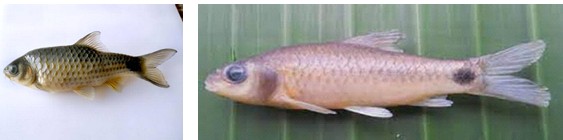
Context: The second new species named Puntius euspilurus is an edible freshwater fish found in the Mananthavady river in Wayanad. The epithet euspilurus is a Greek word referring to the distinct black spot on the caudal fin. The slender bodied fish prefers fast flowing, shallow and clear waters and occurs only in unpolluted areas. It appears in great numbers in paddy fields during the onset of the Southwest monsoon.

Suppose that the supply schedule of this Fish is given in the table below which follows a linear relationship between price and quantity supplied.

PRICE P PER KG (IN ₹)QUANTITY (X) OF FISH SUPPLIED (IN KG)
25800
20700
15600
10500
5400

Suppose that this Fish can be sold only in the Kerala. The Kerala demand schedule for this Fish is as follows and there is a linear relationship between price and quantity demanded.

PRICE(p) PER KG (IN ₹)QUANTITY (x) OF FISH DEMANDED (IN KG)
25200
20400
15600
10800
51000
Q1
Which of the following represents the Price (p) - supply(x) relationship?
a) \( p = 65 - \frac{x}{20} \)     b) \( p = 65 + \frac{x}{20} \)
c) \( p = -15 + \frac{x}{20} \)     d) \( p = 15 - \frac{x}{20} \)

Answer: c) \( p = -15 + \frac{x}{20} \)

We take two points from the Supply Table: \( (x_1, p_1) = (800, 25) \) and \( (x_2, p_2) = (700, 20) \).

The slope \( m \) is given by:

\[ m = \frac{p_2 - p_1}{x_2 - x_1} = \frac{20 - 25}{700 - 800} = \frac{-5}{-100} = \frac{1}{20} \]

Using the point-slope form \( p - p_1 = m(x - x_1) \):

\[ p - 25 = \frac{1}{20}(x - 800) \] \[ p = \frac{x}{20} - \frac{800}{20} + 25 \] \[ p = \frac{x}{20} - 40 + 25 \] \[ p = \frac{x}{20} - 15 \]
Q2
The equation of demand curve can be given by
a) \( p = 30 - \frac{x}{40} \)     b) \( p = 30 + \frac{x}{40} \)
c) \( p = 20 - \frac{x}{40} \)     d) \( p = 20 + \frac{x}{40} \)

Answer: a) \( p = 30 - \frac{x}{40} \)

We take two points from the Demand Table: \( (x_1, p_1) = (200, 25) \) and \( (x_2, p_2) = (400, 20) \).

The slope \( m \) is:

\[ m = \frac{20 - 25}{400 - 200} = \frac{-5}{200} = -\frac{1}{40} \]

Equation:

\[ p - 25 = -\frac{1}{40}(x - 200) \] \[ p = -\frac{x}{40} + 5 + 25 \] \[ p = 30 - \frac{x}{40} \]
Q3
The value of x at equilibrium is
a) 1400/3     b) 600
c) 15     d) 200/3

Answer: b) 600

At equilibrium, Demand Price = Supply Price.

From the tables, at Price = 15, Quantity Supplied = 600 and Quantity Demanded = 600.

Alternatively, solving the equations:

\[ -15 + \frac{x}{20} = 30 - \frac{x}{40} \] \[ \frac{x}{20} + \frac{x}{40} = 45 \] \[ \frac{2x + x}{40} = 45 \Rightarrow 3x = 1800 \Rightarrow x = 600 \]
Q4
The equilibrium price is
a) 400     b) 20
c) 600     d) 15

Answer: d) 15

From the tables, at \( x = 600 \), the price \( p \) is 15.

Alternatively, substitute \( x = 600 \) into the demand equation:

\[ p = 30 - \frac{600}{40} = 30 - 15 = 15 \]
Q5
The consumers' surplus at equilibrium price is
a) 18009     b) 13500
c) 9000     d) 4500

Answer: d) 4500

Consumers' Surplus (CS) is the area below the demand curve and above the price line \( p = 15 \), from \( x = 0 \) to \( x = 600 \).

\[ CS = \int_{0}^{600} \text{Demand}(x) \, dx - (\text{Price} \times \text{Quantity}) \] \[ CS = \int_{0}^{600} \left( 30 - \frac{x}{40} \right) dx - (15 \times 600) \] \[ = \left[ 30x - \frac{x^2}{80} \right]_{0}^{600} - 9000 \] \[ = \left[ 30(600) - \frac{(600)^2}{80} \right] - 9000 \] \[ = \left[ 18000 - \frac{360000}{80} \right] - 9000 \] \[ = [ 18000 - 4500 ] - 9000 \] \[ = 13500 - 9000 = 4500 \]

Alternative Method (Area of Triangle):

At \( x=0 \), Demand Price \( p = 30 \). Equilibrium Price \( p = 15 \). Equilibrium Quantity \( x = 600 \).

\[ \text{Area} = \frac{1}{2} \times \text{Base} \times \text{Height} \] \[ = \frac{1}{2} \times 600 \times (30 - 15) = 300 \times 15 = 4500 \]
Scroll to Top