Note:
Scalars vs Vectors: Scalars have magnitude only (e.g., mass, distance). Vectors have magnitude and direction (e.g., displacement, force).
Vector Types:
- Coinitial: Start from the same point.
- Equal: Same magnitude and direction.
- Collinear: Parallel to the same line (direction can be same or opposite).
Q1
Represent graphically a displacement of 40 km, 30° east of north.
Solution:
To represent this vector:
- Draw the North-South and East-West axes.
- Measure an angle of 30° towards the East from the North axis.
- Draw a vector of length corresponding to 40 km (e.g., 4 units) along this line.
Q2
Classify the following measures as scalars and vectors.
(i) 10 kg
(ii) 2 meters north-west
(iii) 40°
(iv) 40 watt
(v) \( 10^{-19} \) coulomb
(vi) \( 20 \text{ m/s}^2 \)
(i) 10 kg
(ii) 2 meters north-west
(iii) 40°
(iv) 40 watt
(v) \( 10^{-19} \) coulomb
(vi) \( 20 \text{ m/s}^2 \)
Solution:
- (i) Scalar: Mass (magnitude only).
- (ii) Vector: Displacement (magnitude + direction).
- (iii) Scalar: Angle (magnitude).
- (iv) Scalar: Power (magnitude only).
- (v) Scalar: Charge (magnitude only).
- (vi) Vector: Acceleration (magnitude + direction).
Q3
Classify the following as scalar and vector quantities.
(i) time period
(ii) distance
(iii) force
(iv) velocity
(v) work done
(i) time period
(ii) distance
(iii) force
(iv) velocity
(v) work done
Solution:
- (i) Scalar: Time.
- (ii) Scalar: Distance (path length).
- (iii) Vector: Force.
- (iv) Vector: Velocity.
- (v) Scalar: Work done.
Q4
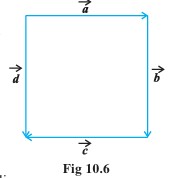
In Fig 10.6 (a square), identify the following vectors.
(i) Coinitial
(ii) Equal
(iii) Collinear but not equal
Solution:
- (i) Coinitial: Vectors starting from the same point.
From the figure, \( \vec{a} \) and \( \vec{d} \) start from the same vertex.
Ans: \( \vec{a} \) and \( \vec{d} \). - (ii) Equal: Vectors with same magnitude and direction.
From the figure, \( \vec{d} \) and \( \vec{b} \) correspond to opposite sides of the square and point in the same direction.
Ans: \( \vec{d} \) and \( \vec{b} \). - (iii) Collinear but not equal: Parallel vectors with different directions.
\( \vec{a} \) and \( \vec{c} \) are parallel but point in opposite directions.
Ans: \( \vec{a} \) and \( \vec{c} \).
Q5
Answer the following as true or false.
(i) \( \vec{a} \) and \( -\vec{a} \) are collinear.
(ii) Two collinear vectors are always equal in magnitude.
(iii) Two vectors having same magnitude are collinear.
(iv) Two collinear vectors having the same magnitude are equal.
(i) \( \vec{a} \) and \( -\vec{a} \) are collinear.
(ii) Two collinear vectors are always equal in magnitude.
(iii) Two vectors having same magnitude are collinear.
(iv) Two collinear vectors having the same magnitude are equal.
Solution:
- (i) True: They are parallel (antiparallel).
- (ii) False: Collinear means parallel; magnitude can differ.
- (iii) False: Same magnitude doesn't imply parallel direction.
- (iv) False: They could be opposite in direction (e.g., \( \vec{a} \) and \( -\vec{a} \)).