
Q1
Maximise \( Z = 3x + 4y \), subject to the constraints: \( x + y \leq 4, x \geq 0, y \geq 0 \).
Solution:
The feasible region determined by the constraints \( x + y \leq 4, x \geq 0, y \geq 0 \) is as follows:
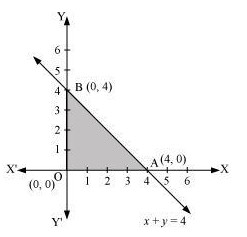
The corner points of the feasible region are \( O(0, 0) \), \( A(4, 0) \), and \( B(0, 4) \). The values of \( Z \) at these points are as follows:
| Corner point | \( Z = 3x + 4y \) |
|---|---|
| \( O(0, 0) \) | 0 |
| \( A(4, 0) \) | 12 |
| \( B(0, 4) \) | 16 \(\to\) Maximum |
Therefore, the maximum value of \( Z \) is 16 at the point \( B(0, 4) \).
Q2
Minimise \( Z = -3x + 4y \), subject to \( x + 2y \leq 8, 3x + 2y \leq 12, x \geq 0, y \geq 0 \).
Solution:
The feasible region determined by the system of constraints \( x + 2y \leq 8 \), \( 3x + 2y \leq 12 \), \( x \geq 0 \), and \( y \geq 0 \) is as follows:
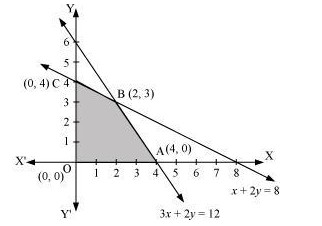
The corner points of the feasible region are \( O(0, 0) \), \( A(4, 0) \), \( B(2, 3) \), and \( C(0, 4) \). The values of \( Z \) at these corner points are as follows:
| Corner point | \( Z = -3x + 4y \) |
|---|---|
| \( O(0, 0) \) | 0 |
| \( A(4, 0) \) | -12 \(\to\) Minimum |
| \( B(2, 3) \) | 6 |
| \( C(0, 4) \) | 16 |
Therefore, the minimum value of \( Z \) is -12 at the point \( (4, 0) \).
Q3
Maximise \( Z = 5x + 3y \) subject to \( 3x + 5y \leq 15, 5x + 2y \leq 10, x \geq 0, y \geq 0 \).
Solution:
The feasible region determined by the system of constraints is as follows:
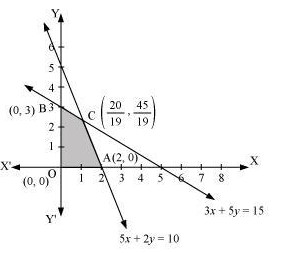
The corner points of the feasible region are \( O(0, 0) \), \( A(2, 0) \), \( B(0, 3) \), and \( C\left(\frac{20}{19}, \frac{45}{19}\right) \). The values of \( Z \) at these corner points are as follows:
| Corner point | \( Z = 5x + 3y \) |
|---|---|
| \( O(0, 0) \) | 0 |
| \( A(2, 0) \) | 10 |
| \( B(0, 3) \) | 9 |
| \( C\left(\frac{20}{19}, \frac{45}{19}\right) \) | \( \frac{235}{19} \) \(\to\) Maximum |
Therefore, the maximum value of \( Z \) is \( \frac{235}{19} \) at the point \( \left(\frac{20}{19}, \frac{45}{19}\right) \).
Q4
Minimise \( Z = 3x + 5y \) such that: \( x + 3y \geq 3, x + y \geq 2, x, y \geq 0 \).
Solution:
The feasible region determined by the system of constraints is unbounded.
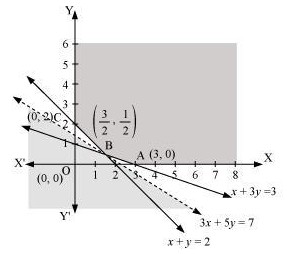
The corner points of the feasible region are \( A(3, 0) \), \( B\left(\frac{3}{2}, \frac{1}{2}\right) \), and \( C(0, 2) \). The values of \( Z \) at these corner points are as follows:
| Corner point | \( Z = 3x + 5y \) |
|---|---|
| \( A(3, 0) \) | 9 |
| \( B\left(\frac{3}{2}, \frac{1}{2}\right) \) | 7 \(\to\) Smallest |
| \( C(0, 2) \) | 10 |
As the feasible region is unbounded, therefore, 7 may or may not be the minimum value of \( Z \).
For this, we draw the graph of the inequality \( 3x + 5y < 7 \), and check whether the resulting half plane has points in common with the feasible region or not.
It can be seen that the feasible region has no common point with \( 3x + 5y < 7 \). Therefore, the minimum value of \( Z \) is 7 at \( \left(\frac{3}{2}, \frac{1}{2}\right) \).
Q5
Maximise \( Z = 3x + 2y \) subject to: \( x + 2y \leq 10, 3x + y \leq 15, x, y \geq 0 \).
Solution:
The feasible region determined by the constraints is as follows:
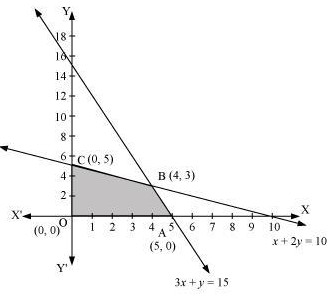
The corner points of the feasible region are \( A(5, 0) \), \( B(4, 3) \), and \( C(0, 5) \). The values of \( Z \) at these corner points are as follows:
| Corner point | \( Z = 3x + 2y \) |
|---|---|
| \( A(5, 0) \) | 15 |
| \( B(4, 3) \) | 18 \(\to\) Maximum |
| \( C(0, 5) \) | 10 |
Therefore, the maximum value of \( Z \) is 18 at the point \( (4, 3) \).
Q6
Minimise \( Z = x + 2y \) subject to \( 2x + y \geq 3, x + 2y \geq 6, x, y \geq 0 \).
Solution:
The feasible region determined by the constraints is as follows:
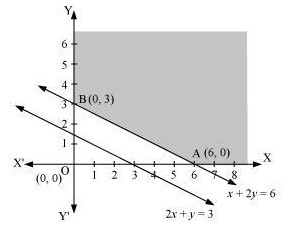
The corner points of the feasible region are \( A(6, 0) \) and \( B(0, 3) \). The values of \( Z \) at these corner points are as follows:
| Corner point | \( Z = x + 2y \) |
|---|---|
| \( A(6, 0) \) | 6 |
| \( B(0, 3) \) | 6 |
It can be seen that the value of \( Z \) at points A and B is same. If we take any other point such as \( (2, 2) \) on line \( x + 2y = 6 \), then \( Z = 6 \).
Thus, the minimum value of \( Z \) occurs for more than 2 points.
Therefore, the value of \( Z \) is minimum at every point on the line \( x + 2y = 6 \).
Q7
Minimise and Maximise \( Z = 5x + 10y \) subject to \( x + 2y \leq 120, x + y \geq 60, x - 2y \geq 0, x, y \geq 0 \).
Solution:
The feasible region determined by the constraints is as follows:
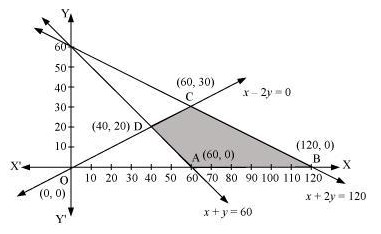
The corner points of the feasible region are \( A(60, 0) \), \( B(120, 0) \), \( C(60, 30) \), and \( D(40, 20) \). The values of \( Z \) at these corner points are as follows:
| Corner point | \( Z = 5x + 10y \) |
|---|---|
| \( A(60, 0) \) | 300 \(\to\) Minimum |
| \( B(120, 0) \) | 600 \(\to\) Maximum |
| \( C(60, 30) \) | 600 \(\to\) Maximum |
| \( D(40, 20) \) | 400 |
The minimum value of \( Z \) is 300 at \( (60, 0) \) and the maximum value of \( Z \) is 600 at all the points on the line segment joining \( (120, 0) \) and \( (60, 30) \).
Q8
Minimise and Maximise \( Z = x + 2y \) subject to \( x + 2y \geq 100, 2x - y \leq 0, 2x + y \leq 200; x, y \geq 0 \).
Solution:
The feasible region determined by the constraints is as follows:
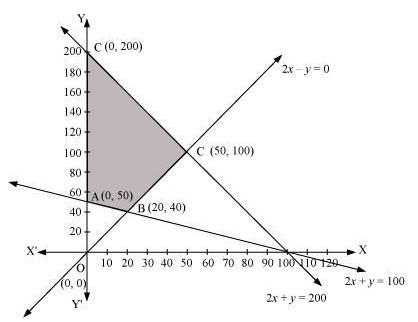
The corner points of the feasible region are \( A(0, 50) \), \( B(20, 40) \), \( C(50, 100) \), and \( D(0, 200) \). The values of \( Z \) at these corner points are as follows:
| Corner point | \( Z = x + 2y \) |
|---|---|
| \( A(0, 50) \) | 100 \(\to\) Minimum |
| \( B(20, 40) \) | 100 \(\to\) Minimum |
| \( C(50, 100) \) | 250 |
| \( D(0, 200) \) | 400 \(\to\) Maximum |
The maximum value of \( Z \) is 400 at \( (0, 200) \) and the minimum value of \( Z \) is 100 at all the points on the line segment joining the points \( (0, 50) \) and \( (20, 40) \).
Q9
Maximise \( Z = -x + 2y \), subject to the constraints: \( x \geq 3, x + y \geq 5, x + 2y \geq 6, y \geq 0 \).
Solution:
The feasible region determined by the constraints is as follows:
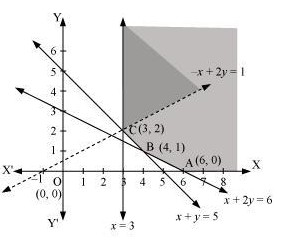
It can be seen that the feasible region is unbounded.
The values of \( Z \) at corner points \( A(6, 0) \), \( B(4, 1) \), and \( C(3, 2) \) are as follows:
| Corner point | \( Z = -x + 2y \) |
|---|---|
| \( A(6, 0) \) | \( Z = -6 \) |
| \( B(4, 1) \) | \( Z = -2 \) |
| \( C(3, 2) \) | \( Z = 1 \) |
As the feasible region is unbounded, therefore, \( Z = 1 \) may or may not be the maximum value. For this, we graph the inequality \( -x + 2y > 1 \), and check whether the resulting half plane has points in common with the feasible region or not.
The resulting feasible region has points in common with the feasible region. Therefore, \( Z = 1 \) is not the maximum value. \( Z \) has no maximum value.
Q10
Maximise \( Z = x + y \), subject to \( x - y \leq -1, -x + y \leq 0, x, y \geq 0 \).
Solution:
The region determined by the constraints, \( x - y \leq -1, -x + y \leq 0, x, y \geq 0 \), is as follows:
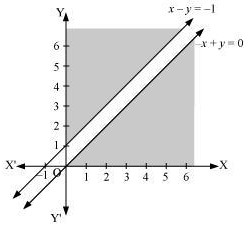
There is no feasible region and thus, \( Z \) has no maximum value.