Note:
Second Derivative Test:
1. Find \( f'(x) \) and set it to 0 to find critical points \( c \).
2. Find \( f''(x) \) and evaluate it at \( c \).
- If \( f''(c) < 0 \), then \( x=c \) is a point of Local Maxima.
- If \( f''(c) > 0 \), then \( x=c \) is a point of Local Minima.
- If \( f''(c) = 0 \), the test fails (use First Derivative Test).
Q1
Find the maximum and minimum values, if any, of the following functions given by
(i) \( f(x) = (2x - 1)^2 + 3 \)
(ii) \( f(x) = 9x^2 + 12x + 2 \)
(iii) \( f(x) = -(x - 1)^2 + 10 \)
(iv) \( g(x) = x^3 + 1 \)
(i) \( f(x) = (2x - 1)^2 + 3 \)
(ii) \( f(x) = 9x^2 + 12x + 2 \)
(iii) \( f(x) = -(x - 1)^2 + 10 \)
(iv) \( g(x) = x^3 + 1 \)
Solution:
(i) \( f(x) = (2x - 1)^2 + 3 \)
Method: We know that \( (2x-1)^2 \ge 0 \) for all \( x \in \mathbb{R} \).
Therefore, \( f(x) \ge 0 + 3 \).
Minimum value: 3 (at \( 2x-1=0 \Rightarrow x=1/2 \)).
Maximum value: None (value can go to infinity).
(ii) \( f(x) = 9x^2 + 12x + 2 \)
\( f(x) = (3x)^2 + 2(3x)(2) + 4 - 2 = (3x+2)^2 - 2 \).
Since \( (3x+2)^2 \ge 0 \), \( f(x) \ge -2 \).
Minimum value: -2 (at \( x=-2/3 \)).
Maximum value: None.
(iii) \( f(x) = -(x - 1)^2 + 10 \)
Since \( (x-1)^2 \ge 0 \), we have \( -(x-1)^2 \le 0 \).
Adding 10 to both sides: \( -(x-1)^2 + 10 \le 10 \).
Maximum value: 10 (at \( x=1 \)).
Minimum value: None.
(iv) \( g(x) = x^3 + 1 \)
\( g'(x) = 3x^2 \). Setting \( g'(x) = 0 \Rightarrow x = 0 \).
Test: For \( x < 0 \), \( g'(x) > 0 \). For \( x > 0 \), \( g'(x) > 0 \).
Since the sign of \( g'(x) \) does not change, \( x=0 \) is a point of inflection.
Ans: No maximum or minimum value.
Q2
Find the maximum and minimum values, if any, of the following functions given by
(i) \( f(x) = |x + 2| - 1 \)
(ii) \( g(x) = -|x + 1| + 3 \)
(iii) \( h(x) = \sin(2x) + 5 \)
(iv) \( f(x) = |\sin 4x + 3| \)
(v) \( h(x) = x + 1, x \in (-1, 1) \)
(i) \( f(x) = |x + 2| - 1 \)
(ii) \( g(x) = -|x + 1| + 3 \)
(iii) \( h(x) = \sin(2x) + 5 \)
(iv) \( f(x) = |\sin 4x + 3| \)
(v) \( h(x) = x + 1, x \in (-1, 1) \)
Solution:
(i) \( |x+2| \ge 0 \Rightarrow |x+2| - 1 \ge -1 \).
Min value: -1. Max value: None.
(ii) \( |x+1| \ge 0 \Rightarrow -|x+1| \le 0 \Rightarrow -|x+1|+3 \le 3 \).
Max value: 3. Min value: None.
(iii) We know \( -1 \le \sin(2x) \le 1 \).
Add 5: \( 4 \le \sin(2x) + 5 \le 6 \).
Max value: 6. Min value: 4.
(iv) \( -1 \le \sin(4x) \le 1 \).
Add 3: \( 2 \le \sin(4x) + 3 \le 4 \).
Taking modulus: \( 2 \le |\sin 4x + 3| \le 4 \).
Max value: 4. Min value: 2.
(v) \( h(x) = x + 1 \) on \( (-1, 1) \).
The function is strictly increasing. Since the interval is open, the function approaches 0 and 2 but never reaches them.
Ans: No maximum or minimum value.
Q3
Find the local maxima and local minima... using derivative tests:
(i) \( f(x) = x^2 \)
(ii) \( g(x) = x^3 - 3x \)
(iii) \( h(x) = \sin x + \cos x, 0 < x < \frac{\pi}{2} \)
(iv) \( f(x) = \sin x - \cos x, 0 < x < 2\pi \)
(v) \( f(x) = x^3 - 6x^2 + 9x + 15 \)
(vi) \( g(x) = \frac{x}{2} + \frac{2}{x}, x > 0 \)
(vii) \( g(x) = \frac{1}{x^2 + 2} \)
(viii) \( f(x) = x\sqrt{1-x}, 0 < x < 1 \)
(i) \( f(x) = x^2 \)
(ii) \( g(x) = x^3 - 3x \)
(iii) \( h(x) = \sin x + \cos x, 0 < x < \frac{\pi}{2} \)
(iv) \( f(x) = \sin x - \cos x, 0 < x < 2\pi \)
(v) \( f(x) = x^3 - 6x^2 + 9x + 15 \)
(vi) \( g(x) = \frac{x}{2} + \frac{2}{x}, x > 0 \)
(vii) \( g(x) = \frac{1}{x^2 + 2} \)
(viii) \( f(x) = x\sqrt{1-x}, 0 < x < 1 \)
Solution:
(i) \( f(x) = x^2 \)
\( f'(x) = 2x \). Set \( 2x = 0 \Rightarrow x = 0 \).
\( f''(x) = 2 \).
At \( x=0 \): \( f''(0) = 2 > 0 \).
Thus, \( x=0 \) is a point of Local Minima.
Local Min Value = \( f(0) = 0 \).
(ii) \( g(x) = x^3 - 3x \)
\( g'(x) = 3x^2 - 3 = 3(x^2 - 1) \). Set \( g'(x) = 0 \Rightarrow x = \pm 1 \).
\( g''(x) = 6x \).
At \( x=1 \): \( g''(1) = 6 > 0 \) (Local Minima). Value = \( 1-3 = -2 \).
At \( x=-1 \): \( g''(-1) = -6 < 0 \) (Local Maxima). Value = \( -1+3 = 2 \).
(iii) \( h(x) = \sin x + \cos x, 0 < x < \frac{\pi}{2} \)
\( h'(x) = \cos x - \sin x \). Set \( h'(x) = 0 \Rightarrow \tan x = 1 \Rightarrow x = \pi/4 \).
\( h''(x) = -\sin x - \cos x \).
At \( x=\pi/4 \): \( h''(\pi/4) = -(\frac{1}{\sqrt{2}} + \frac{1}{\sqrt{2}}) = -\sqrt{2} < 0 \).
Thus, \( x=\pi/4 \) is Local Maxima. Value = \( \sqrt{2} \).
(iv) \( f(x) = \sin x - \cos x, 0 < x < 2\pi \)
\( f'(x) = \cos x + \sin x \). Set \( f'(x)=0 \Rightarrow \tan x = -1 \).
\( x = \frac{3\pi}{4}, \frac{7\pi}{4} \).
\( f''(x) = -\sin x + \cos x \).
At \( x=\frac{3\pi}{4} \): \( f'' = -\frac{1}{\sqrt{2}} + (-\frac{1}{\sqrt{2}}) = -\sqrt{2} < 0 \) (Maxima).
At \( x=\frac{7\pi}{4} \): \( f'' = -(-\frac{1}{\sqrt{2}}) + \frac{1}{\sqrt{2}} = \sqrt{2} > 0 \) (Minima).
Max Value = \( \sqrt{2} \), Min Value = \( -\sqrt{2} \).
(v) \( f(x) = x^3 - 6x^2 + 9x + 15 \)
\( f'(x) = 3x^2 - 12x + 9 = 3(x^2 - 4x + 3) = 3(x-1)(x-3) \).
CP: \( x=1, 3 \).
\( f''(x) = 6x - 12 \).
At \( x=1 \): \( f''(1) = -6 < 0 \) (Maxima). Value = 19.
At \( x=3 \): \( f''(3) = 6 > 0 \) (Minima). Value = 15.
(vi) \( g(x) = \frac{x}{2} + \frac{2}{x} \)
\( g'(x) = \frac{1}{2} - \frac{2}{x^2} \). Set \( g'(x)=0 \Rightarrow x^2=4 \Rightarrow x=2 \) (since \( x>0 \)).
\( g''(x) = 0 - 2(-2x^{-3}) = \frac{4}{x^3} \).
At \( x=2 \): \( g''(2) = \frac{4}{8} > 0 \) (Minima).
Local Min Value = \( 1+1=2 \).
(vii) \( g(x) = \frac{1}{x^2 + 2} \)
\( g'(x) = \frac{-2x}{(x^2+2)^2} \). CP: \( x=0 \).
Using First Derivative Test:
\( x<0 \Rightarrow g'(x)>0 \) (Increasing).
\( x>0 \Rightarrow g'(x)<0 \) (Decreasing).
Sign change from + to - implies Local Maxima at \( x=0 \). Value = \( 1/2 \).
(viii) \( f(x) = x\sqrt{1-x} \)
\( f'(x) = 1\cdot\sqrt{1-x} + x\frac{-1}{2\sqrt{1-x}} = \frac{2(1-x)-x}{2\sqrt{1-x}} = \frac{2-3x}{2\sqrt{1-x}} \).
CP: \( 2-3x=0 \Rightarrow x=2/3 \).
Sign of \( f'(x) \): For \( x < 2/3 \), \( f'>0 \). For \( x > 2/3 \), \( f'<0 \).
Change from + to - implies Local Maxima.
Value = \( \frac{2}{3}\sqrt{1/3} = \frac{2}{3\sqrt{3}} \).
Q4
Prove that the following functions do not have maxima or minima:
(i) \( f(x) = e^x \)
(ii) \( g(x) = \log x \)
(iii) \( h(x) = x^3 + x^2 + x + 1 \)
(i) \( f(x) = e^x \)
(ii) \( g(x) = \log x \)
(iii) \( h(x) = x^3 + x^2 + x + 1 \)
Solution:
(i) \( f'(x) = e^x \).
Since \( e^x > 0 \) for all real \( x \), \( f'(x) \) is never 0. No critical points. Thus, no local maxima or minima.
(ii) \( g'(x) = \frac{1}{x} \).
For the domain \( x > 0 \), \( g'(x) \neq 0 \). No critical points. No maxima or minima.
(iii) \( h'(x) = 3x^2 + 2x + 1 \).
Discriminant \( D = b^2 - 4ac = 4 - 12 = -8 < 0 \).
Since \( a=3 > 0 \) and \( D < 0 \), the quadratic \( 3x^2+2x+1 \) is always positive.
So \( h'(x) > 0 \) for all \( x \). The function is strictly increasing. No maxima or minima.
Q5
Find the absolute maximum and minimum values in the given intervals:
(i) \( f(x) = x^3, x \in [-2, 2] \)
(ii) \( f(x) = \sin x + \cos x, x \in [0, \pi] \)
(iii) \( f(x) = 4x - \frac{1}{2}x^2, x \in [-2, \frac{9}{2}] \)
(iv) \( f(x) = (x - 1)^2 + 3, x \in [-3, 1] \)
(i) \( f(x) = x^3, x \in [-2, 2] \)
(ii) \( f(x) = \sin x + \cos x, x \in [0, \pi] \)
(iii) \( f(x) = 4x - \frac{1}{2}x^2, x \in [-2, \frac{9}{2}] \)
(iv) \( f(x) = (x - 1)^2 + 3, x \in [-3, 1] \)
Solution:
(i) \( f'(x) = 3x^2 = 0 \Rightarrow x=0 \).
Evaluate at CP and endpoints:
\( f(-2) = -8 \).
\( f(0) = 0 \).
\( f(2) = 8 \).
Abs Max: 8. Abs Min: -8.
(ii) \( f'(x) = \cos x - \sin x = 0 \Rightarrow \tan x = 1 \Rightarrow x = \pi/4 \).
\( f(0) = 0 + 1 = 1 \).
\( f(\pi/4) = \frac{1}{\sqrt{2}} + \frac{1}{\sqrt{2}} = \sqrt{2} \approx 1.414 \).
\( f(\pi) = 0 - 1 = -1 \).
Abs Max: \( \sqrt{2} \). Abs Min: -1.
(iii) \( f'(x) = 4 - x = 0 \Rightarrow x=4 \).
\( f(-2) = 4(-2) - 0.5(4) = -8 - 2 = -10 \).
\( f(4) = 16 - 0.5(16) = 16 - 8 = 8 \).
\( f(4.5) = 4(4.5) - 0.5(20.25) = 18 - 10.125 = 7.875 \).
Abs Max: 8. Abs Min: -10.
(iv) \( f'(x) = 2(x-1) = 0 \Rightarrow x=1 \).
\( f(-3) = (-4)^2 + 3 = 19 \).
\( f(1) = 0 + 3 = 3 \).
Abs Max: 19. Abs Min: 3.
Q6
Find the maximum profit that a company can make, if the profit function is given by \( p(x) = 41 - 72x - 18x^2 \).
Solution:
Given \( p(x) = 41 - 72x - 18x^2 \).
\( p'(x) = -72 - 36x \).
For critical point: \( -72 - 36x = 0 \Rightarrow 36x = -72 \Rightarrow x = -2 \).
Second Derivative Check: \( p''(x) = -36 \).
Since \( p''(-2) = -36 < 0 \), \( x=-2 \) is a point of local maxima.
Max Profit = \( p(-2) = 41 - 72(-2) - 18(4) = 41 + 144 - 72 = 113 \).
Ans: 113.
Q7
Find both the maximum value and the minimum value of \( 3x^4 - 8x^3 + 12x^2 - 48x + 25 \) on the interval \( [0, 3] \).
Solution:
Let \( f(x) = 3x^4 - 8x^3 + 12x^2 - 48x + 25 \).
\( f'(x) = 12x^3 - 24x^2 + 24x - 48 \).
\( = 12(x^3 - 2x^2 + 2x - 4) = 12[x^2(x-2) + 2(x-2)] \).
\( = 12(x-2)(x^2+2) \).
Setting \( f'(x)=0 \), real root is \( x=2 \) (since \( x^2+2=0 \) has no real roots).
Evaluate at critical point \( x=2 \) and endpoints \( x=0, 3 \):
- \( f(0) = 25 \).
- \( f(2) = 3(16) - 8(8) + 12(4) - 48(2) + 25 = 48 - 64 + 48 - 96 + 25 = -39 \).
- \( f(3) = 3(81) - 8(27) + 12(9) - 48(3) + 25 = 243 - 216 + 108 - 144 + 25 = 16 \).
Maximum Value: 25. Minimum Value: -39.
Q8
At what points in the interval \( [0, 2\pi] \), does the function \( \sin 2x \) attain its maximum value?
Solution:
Let \( f(x) = \sin 2x \). We know the maximum value of sine function is 1.
\( \sin 2x = 1 \).
General solution: \( 2x = 2n\pi + \frac{\pi}{2} \).
For \( x \in [0, 2\pi] \), \( 2x \in [0, 4\pi] \).
Possible values for \( 2x \): \( \frac{\pi}{2}, \frac{5\pi}{2} \).
Values for \( x \): \( \frac{\pi}{4}, \frac{5\pi}{4} \).
Ans: \( x = \frac{\pi}{4} \) and \( x = \frac{5\pi}{4} \).
Q9
What is the maximum value of the function \( \sin x + \cos x \)?
Solution:
Let \( f(x) = \sin x + \cos x \).
\( f'(x) = \cos x - \sin x \). Set \( f'(x) = 0 \Rightarrow \tan x = 1 \Rightarrow x = \pi/4 \) (principal).
\( f''(x) = -\sin x - \cos x \).
At \( x=\pi/4 \), \( f'' < 0 \). Maxima.
Max Value = \( \sin(\pi/4) + \cos(\pi/4) = \frac{1}{\sqrt{2}} + \frac{1}{\sqrt{2}} = \sqrt{2} \).
Q10
Find the maximum value of \( 2x^3 - 24x + 107 \) in the interval \( [1, 3] \). Find the maximum value of the same function in \( [-3, -1] \).
Solution:
\( f(x) = 2x^3 - 24x + 107 \).
\( f'(x) = 6x^2 - 24 = 6(x^2 - 4) \). Critical points: \( x = \pm 2 \).
Interval [1, 3]: Only \( x=2 \) is in interval.
\( f(1) = 2 - 24 + 107 = 85 \).
\( f(2) = 16 - 48 + 107 = 75 \).
\( f(3) = 54 - 72 + 107 = 89 \).
Max Value: 89.
Interval [-3, -1]: Only \( x=-2 \) is in interval.
\( f(-3) = -54 + 72 + 107 = 125 \).
\( f(-2) = -16 + 48 + 107 = 139 \).
\( f(-1) = -2 + 24 + 107 = 129 \).
Max Value: 139.
Q11
It is given that at \( x = 1 \), the function \( x^4 - 62x^2 + ax + 9 \) attains its maximum value, on the interval \( [0, 2] \). Find the value of \( a \).
Solution:
Let \( f(x) = x^4 - 62x^2 + ax + 9 \).
\( f'(x) = 4x^3 - 124x + a \).
Since the function attains maximum at \( x=1 \), \( f'(1) \) must be 0.
\( 4(1)^3 - 124(1) + a = 0 \).
\( 4 - 124 + a = 0 \Rightarrow a - 120 = 0 \Rightarrow a = 120 \).
Q12
Find the maximum and minimum values of \( x + \sin 2x \) on \( [0, 2\pi] \).
Solution:
\( f(x) = x + \sin 2x \).
\( f'(x) = 1 + 2\cos 2x \). Set \( f'(x)=0 \Rightarrow \cos 2x = -1/2 \).
\( 2x = 2\pi/3, 4\pi/3, 8\pi/3, 10\pi/3 \) (within \( [0, 4\pi] \)).
\( x = \pi/3, 2\pi/3, 4\pi/3, 5\pi/3 \).
Evaluating:
\( f(0) = 0 \).
\( f(\pi/3) = \pi/3 + \sqrt{3}/2 \).
\( f(2\pi/3) = 2\pi/3 - \sqrt{3}/2 \).
\( f(4\pi/3) = 4\pi/3 + \sqrt{3}/2 \).
\( f(5\pi/3) = 5\pi/3 - \sqrt{3}/2 \).
\( f(2\pi) = 2\pi \).
Max is \( 2\pi \) (approx 6.28). Min is 0.
Q13
Find two numbers whose sum is 24 and whose product is as large as possible.
Solution:
Let numbers be \( x \) and \( 24-x \).
Product \( P(x) = x(24-x) = 24x - x^2 \).
\( P'(x) = 24 - 2x \). Set \( P'(x)=0 \Rightarrow x=12 \).
Second Derivative Test: \( P''(x) = -2 < 0 \).
Thus, \( x=12 \) gives a Maximum.
Numbers are 12 and 12.
Q14
Find two positive numbers \( x \) and \( y \) such that \( x + y = 60 \) and \( xy^3 \) is maximum.
Solution:
Given \( x + y = 60 \Rightarrow x = 60 - y \).
Let function \( f(y) = (60 - y)y^3 = 60y^3 - y^4 \).
\( f'(y) = 180y^2 - 4y^3 = 4y^2(45 - y) \).
Set \( f'(y)=0 \Rightarrow y=45 \) (since \( y>0 \)).
\( f''(y) = 360y - 12y^2 \).
At \( y=45 \): \( f''(45) = 360(45) - 12(45)^2 = 45(360 - 540) < 0 \).
Thus, Maxima at \( y=45 \). \( x = 60 - 45 = 15 \).
Numbers are 15 and 45.
Q15
Find two positive numbers \( x \) and \( y \) such that their sum is 35 and the product \( x^2 y^5 \) is a maximum.
Solution:
\( x + y = 35 \Rightarrow x = 35 - y \).
Let \( P(y) = (35 - y)^2 y^5 \).
\( P'(y) = 2(35-y)(-1)y^5 + (35-y)^2(5y^4) \)
\( = y^4(35-y) [-2y + 5(35-y)] \)
\( = y^4(35-y) [175 - 7y] \).
Critical points: \( y=35 \) (product 0, rejected), \( y=25 \).
Sign Test for \( P'(y) \):
For \( y < 25 \), \( P' > 0 \). For \( y > 25 \), \( P' < 0 \).
Change from + to - implies Maxima.
So \( y=25, x=10 \).
Q16
Find two positive numbers whose sum is 16 and the sum of whose cubes is minimum.
Solution:
Let numbers be \( x \) and \( 16-x \).
Function \( S(x) = x^3 + (16-x)^3 \).
\( S'(x) = 3x^2 + 3(16-x)^2(-1) = 3x^2 - 3(256 - 32x + x^2) \)
\( = 3x^2 - 768 + 96x - 3x^2 = 96x - 768 \).
Set \( S'(x) = 0 \Rightarrow 96x = 768 \Rightarrow x = 8 \).
2nd Derivative: \( S''(x) = 96 > 0 \).
Therefore, Minima at \( x=8 \).
Numbers are 8 and 8.
Q17
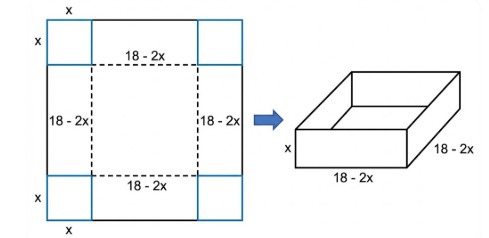
A square piece of tin of side 18 cm is to be made into a box without top, by cutting a square from each corner and folding up the flaps to form the box. What should be the side of the square to be cut off so that the volume of the box is the maximum possible?
Solution:
Let the side of the square to be cut off be \( x \) cm.
After cutting squares of side \( x \) from each corner, the dimensions of the box will be:
- Length \( L = 18 - 2x \)
- Breadth \( B = 18 - 2x \)
- Height \( H = x \)
Volume \( V = L \times B \times H = x(18 - 2x)^2 \).
Differentiating w.r.t \( x \):
\( V'(x) = 1 \cdot (18 - 2x)^2 + x \cdot 2(18 - 2x)(-2) \)
\( = (18 - 2x) [ (18 - 2x) - 4x ] \)
\( = (18 - 2x) (18 - 6x) \).
For critical points, set \( V'(x) = 0 \):
\( 18 - 2x = 0 \Rightarrow x = 9 \) (Not possible as \( 18-2(9)=0 \))
\( 18 - 6x = 0 \Rightarrow x = 3 \).
Second Derivative Test:
\( V''(x) = \frac{d}{dx} [ (18 - 2x)(18 - 6x) ] \)
\( = -2(18 - 6x) + (18 - 2x)(-6) \)
\( = -36 + 12x - 108 + 12x = 24x - 144 \).
At \( x = 3 \): \( V''(3) = 24(3) - 144 = 72 - 144 = -72 < 0 \).
Since \( V'' < 0 \), volume is maximum at \( x = 3 \).
Ans: The side of the square to be cut off is 3 cm.
Q18
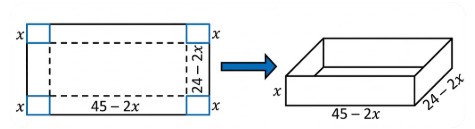
A rectangular sheet of tin 45 cm by 24 cm is to be made into a box without top, by cutting off square from each corner and folding up the flaps. What should be the side of the square to be cut off so that the volume of the box is maximum?
Solution:
Let side of cut square be \( x \) cm.
Dimensions of box: Length \( = 45 - 2x \), Breadth \( = 24 - 2x \), Height \( = x \).
Volume \( V = x(45 - 2x)(24 - 2x) \)
\( V = x(1080 - 90x - 48x + 4x^2) \)
\( V = 4x^3 - 138x^2 + 1080x \).
\( V'(x) = 12x^2 - 276x + 1080 \).
Set \( V'(x) = 0 \):
\( 12(x^2 - 23x + 90) = 0 \)
\( 12(x - 18)(x - 5) = 0 \).
Possible values: \( x = 18 \) or \( x = 5 \).
Since breadth is 24, \( x \) cannot be 18 (as \( 24 - 2(18) < 0 \)). So, \( x = 5 \).
Second Derivative Test:
\( V''(x) = 24x - 276 \).
At \( x = 5 \): \( V''(5) = 24(5) - 276 = 120 - 276 = -156 < 0 \).
So, Volume is maximum at \( x = 5 \).
Ans: Side of square is 5 cm.
Q19
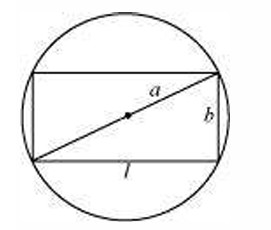
Show that of all the rectangles inscribed in a given fixed circle, the square has the maximum area.
Solution:
Let the circle have radius \( R \) (constant). Let rectangle dimensions be \( 2x \) and \( 2y \).
From geometry: \( x^2 + y^2 = R^2 \Rightarrow y = \sqrt{R^2 - x^2} \).
Area \( A = (2x)(2y) = 4xy \).
To maximize \( A \), we can maximize \( Z = A^2 \) (to avoid square roots).
\( Z = 16x^2 y^2 = 16x^2 (R^2 - x^2) = 16(R^2 x^2 - x^4) \).
\( \frac{dZ}{dx} = 16(2R^2 x - 4x^3) \).
Set \( \frac{dZ}{dx} = 0 \Rightarrow 2x(R^2 - 2x^2) = 0 \).
\( x = 0 \) (rejected) or \( x^2 = R^2/2 \Rightarrow x = R/\sqrt{2} \).
Second Derivative Test:
\( \frac{d^2Z}{dx^2} = 16(2R^2 - 12x^2) \).
At \( x^2 = R^2/2 \): \( 16(2R^2 - 6R^2) = -64R^2 < 0 \).
Thus, Area is maximum when \( x = R/\sqrt{2} \).
When \( x = R/\sqrt{2} \), \( y = \sqrt{R^2 - R^2/2} = R/\sqrt{2} \).
Since \( x = y \), the length \( 2x \) equals breadth \( 2y \).
Therefore, the rectangle is a square.
Q20
Show that the right circular cylinder of given surface and maximum volume is such that its height is equal to the diameter of the base.
Solution:
Let surface area be \( S \) (constant), radius \( r \), and height \( h \).
\( S = 2\pi r^2 + 2\pi rh \implies h = \frac{S - 2\pi r^2}{2\pi r} \).
Volume \( V = \pi r^2 h = \pi r^2 \left( \frac{S - 2\pi r^2}{2\pi r} \right) = \frac{r}{2}(S - 2\pi r^2) = \frac{Sr}{2} - \pi r^3 \).
Differentiating w.r.t \( r \):
\( \frac{dV}{dr} = \frac{S}{2} - 3\pi r^2 \).
Set \( \frac{dV}{dr} = 0 \Rightarrow \frac{S}{2} = 3\pi r^2 \Rightarrow S = 6\pi r^2 \).
Substitute \( S \) back into height equation:
\( h = \frac{6\pi r^2 - 2\pi r^2}{2\pi r} = \frac{4\pi r^2}{2\pi r} = 2r \).
Since \( h = 2r \), height is equal to diameter.
Check Maxima: \( \frac{d^2V}{dr^2} = -6\pi r < 0 \). Maxima confirmed.
Q21
Of all the closed cylindrical cans (right circular), of a given volume of 100 cubic centimetres, find the dimensions of the can which has the minimum surface area.
Solution:
Given Volume \( V = \pi r^2 h = 100 \Rightarrow h = \frac{100}{\pi r^2} \).
Surface Area \( S = 2\pi r^2 + 2\pi r h \).
Substitute \( h \): \( S = 2\pi r^2 + 2\pi r \left( \frac{100}{\pi r^2} \right) = 2\pi r^2 + \frac{200}{r} \).
\( \frac{dS}{dr} = 4\pi r - \frac{200}{r^2} \).
Set \( \frac{dS}{dr} = 0 \Rightarrow 4\pi r = \frac{200}{r^2} \Rightarrow r^3 = \frac{50}{\pi} \).
\( r = \sqrt[3]{\frac{50}{\pi}} \).
Second Derivative Test:
\( \frac{d^2S}{dr^2} = 4\pi + \frac{400}{r^3} \).
Since \( r > 0 \), \( S'' > 0 \). Thus, Surface Area is minimum.
Dimensions:
\( r = \left( \frac{50}{\pi} \right)^{1/3} \) cm.
\( h = \frac{100}{\pi r^2} = \frac{2(50)}{\pi r^2} = \frac{2(\pi r^3)}{\pi r^2} = 2r = 2 \left( \frac{50}{\pi} \right)^{1/3} \) cm.
Q22
A wire of length 28 m is to be cut into two pieces. One of the pieces is to be made into a square and the other into a circle. What should be the length of the two pieces so that the combined area of the square and the circle is minimum?
Solution:
Total length = 28 m. Let length for square be \( x \). Then length for circle is \( 28 - x \).
Square: Perimeter \( 4s = x \Rightarrow \text{side } s = x/4 \). Area \( A_s = (x/4)^2 = x^2/16 \).
Circle: Circumference \( 2\pi r = 28 - x \Rightarrow r = \frac{28-x}{2\pi} \).
Area \( A_c = \pi r^2 = \pi \left( \frac{28-x}{2\pi} \right)^2 = \frac{(28-x)^2}{4\pi} \).
Total Area \( A = \frac{x^2}{16} + \frac{(28-x)^2}{4\pi} \).
\( \frac{dA}{dx} = \frac{2x}{16} + \frac{2(28-x)(-1)}{4\pi} = \frac{x}{8} - \frac{28-x}{2\pi} \).
Set \( \frac{dA}{dx} = 0 \Rightarrow \frac{x}{8} = \frac{28-x}{2\pi} \Rightarrow \pi x = 4(28-x) \).
\( \pi x = 112 - 4x \Rightarrow x(\pi + 4) = 112 \Rightarrow x = \frac{112}{\pi + 4} \).
Second Derivative Test:
\( \frac{d^2A}{dx^2} = \frac{1}{8} + \frac{1}{2\pi} > 0 \). Minima confirmed.
Dimensions:
Piece for Square = \( \frac{112}{\pi + 4} \) m.
Piece for Circle = \( 28 - \frac{112}{\pi + 4} = \frac{28\pi + 112 - 112}{\pi + 4} = \frac{28\pi}{\pi + 4} \) m.
Q23
Prove that the volume of the largest cone that can be inscribed in a sphere of radius R is \( \frac{8}{27} \) of the volume of the sphere.
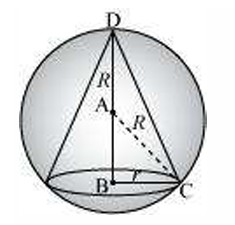
Solution:
Let sphere radius be \( R \). Let cone height be \( h \) and radius \( r \).
Let the center of the sphere be O. Let the distance from O to the base of the cone be \( x \).
Then \( h = R + x \). Also \( r^2 + x^2 = R^2 \Rightarrow r^2 = R^2 - x^2 \).
Volume \( V = \frac{1}{3}\pi r^2 h = \frac{1}{3}\pi (R^2 - x^2)(R + x) \).
\( \frac{dV}{dx} = \frac{\pi}{3} [ (R^2 - x^2)(1) + (R + x)(-2x) ] \)
\( = \frac{\pi}{3} (R + x) [ R - x - 2x ] = \frac{\pi}{3} (R + x) (R - 3x) \).
Set \( \frac{dV}{dx} = 0 \Rightarrow x = R/3 \) (since \( x = -R \) implies height 0).
Second Derivative Test:
At \( x = R/3 \), derivative changes sign from + to -. Maxima.
Max Volume:
Height \( h = R + R/3 = 4R/3 \).
Radius \( r^2 = R^2 - R^2/9 = 8R^2/9 \).
\( V = \frac{1}{3}\pi \left( \frac{8R^2}{9} \right) \left( \frac{4R}{3} \right) = \frac{32\pi R^3}{81} \).
Compare to Sphere Volume \( V_s = \frac{4}{3}\pi R^3 \):
\( V = \frac{8}{27} \left( \frac{4}{3}\pi R^3 \right) = \frac{8}{27} V_s \). Proved.
Q24
Show that the right circular cone of least curved surface and given volume has an altitude equal to \( \sqrt{2} \) time the radius of the base.
Solution:
Let volume \( V \) be constant. \( V = \frac{1}{3}\pi r^2 h \Rightarrow h = \frac{3V}{\pi r^2} \).
Curved Surface Area \( S = \pi r l = \pi r \sqrt{r^2 + h^2} \).
Minimize \( Z = S^2 = \pi^2 r^2 (r^2 + h^2) = \pi^2 r^4 + \pi^2 r^2 h^2 \).
Substitute \( h \):
\( Z = \pi^2 r^4 + \pi^2 r^2 \left( \frac{9V^2}{\pi^2 r^4} \right) = \pi^2 r^4 + \frac{9V^2}{r^2} \).
\( \frac{dZ}{dr} = 4\pi^2 r^3 - \frac{18V^2}{r^3} \).
Set \( \frac{dZ}{dr} = 0 \Rightarrow 2\pi^2 r^6 = 9V^2 \).
Substitute \( V = \frac{1}{3}\pi r^2 h \) into equation:
\( 2\pi^2 r^6 = 9 \left( \frac{1}{9}\pi^2 r^4 h^2 \right) = \pi^2 r^4 h^2 \).
\( 2r^2 = h^2 \Rightarrow h = \sqrt{2}r \).
Second Derivative Test:
\( \frac{d^2Z}{dr^2} = 12\pi^2 r^2 + \frac{54V^2}{r^4} > 0 \). Minima confirmed.
Hence, altitude is \( \sqrt{2} \) times radius.
Q25
Show that the semi-vertical angle of the cone of the maximum volume and of given slant height is \( \tan^{-1}\sqrt{2} \).
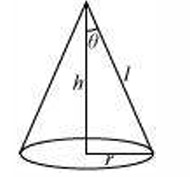
Solution:
Let slant height \( l \) be constant. Let semi-vertical angle be \( \alpha \).
Radius \( r = l \sin \alpha \), Height \( h = l \cos \alpha \).
Volume \( V = \frac{1}{3}\pi r^2 h = \frac{1}{3}\pi (l \sin \alpha)^2 (l \cos \alpha) \)
\( V = \frac{1}{3}\pi l^3 (\sin^2 \alpha \cos \alpha) \).
Differentiating w.r.t \( \alpha \):
\( \frac{dV}{d\alpha} = \frac{\pi l^3}{3} [ 2\sin\alpha\cos\alpha \cdot \cos\alpha + \sin^2\alpha(-\sin\alpha) ] \)
\( = \frac{\pi l^3}{3} \sin\alpha (2\cos^2\alpha - \sin^2\alpha) \).
Set \( \frac{dV}{d\alpha} = 0 \):
\( \sin\alpha \neq 0 \), so \( 2\cos^2\alpha = \sin^2\alpha \).
\( \tan^2\alpha = 2 \Rightarrow \tan\alpha = \sqrt{2} \Rightarrow \alpha = \tan^{-1}\sqrt{2} \).
Second Derivative Test:
Analysis shows \( V'' < 0 \) at this point. Maxima confirmed.
Q26
Show that semi-vertical angle of right circular cone of given surface area and maximum volume is \( \sin^{-1}(\frac{1}{3}) \).
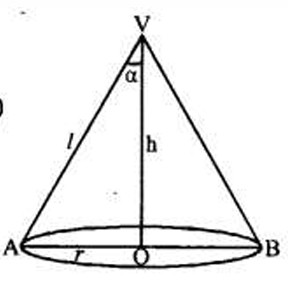
Solution:
Let Total Surface Area \( S \) be constant. \( S = \pi r l + \pi r^2 \).
\( l = \frac{S - \pi r^2}{\pi r} \).
Volume \( V = \frac{1}{3}\pi r^2 h \).
\( V^2 = \frac{1}{9}\pi^2 r^4 (l^2 - r^2) \).
Substitute \( l \):
\( V^2 = \frac{1}{9}\pi^2 r^4 \left[ \left( \frac{S}{\pi r} - r \right)^2 - r^2 \right] \)
\( V^2 = \frac{1}{9}\pi^2 r^4 \left[ \frac{S^2}{\pi^2 r^2} - \frac{2S}{\pi} \right] = \frac{1}{9} ( S^2 r^2 - 2S\pi r^4 ) \).
Differentiating w.r.t \( r \):
\( \frac{d(V^2)}{dr} = \frac{1}{9} ( 2S^2 r - 8S\pi r^3 ) \).
Set to 0: \( 2S^2 r = 8S\pi r^3 \Rightarrow S = 4\pi r^2 \).
Now, we need \( \sin \alpha = \frac{r}{l} \).
From \( S = \pi r l + \pi r^2 \), substitute \( S = 4\pi r^2 \):
\( 4\pi r^2 = \pi r l + \pi r^2 \Rightarrow 3\pi r^2 = \pi r l \Rightarrow l = 3r \).
\( \sin \alpha = \frac{r}{3r} = \frac{1}{3} \).
\( \alpha = \sin^{-1}(1/3) \).
Q27
The point on the curve \( x^2 = 2y \) which is nearest to the point \( (0, 5) \) is
(A) \( (2\sqrt{2}, 4) \) (B) \( (2\sqrt{2}, 0) \)
(C) \( (0, 0) \) (D) \( (2, 2) \)
(A) \( (2\sqrt{2}, 4) \) (B) \( (2\sqrt{2}, 0) \)
(C) \( (0, 0) \) (D) \( (2, 2) \)
Answer: (A)
Solution:
Let point be \( (x, y) \). Distance squared \( D = (x-0)^2 + (y-5)^2 = x^2 + (y-5)^2 \).
Substitute \( x^2 = 2y \):
\( D(y) = 2y + (y-5)^2 = 2y + y^2 - 10y + 25 = y^2 - 8y + 25 \).
\( D'(y) = 2y - 8 \).
Set \( D'(y) = 0 \Rightarrow y = 4 \).
If \( y = 4 \), \( x^2 = 2(4) = 8 \Rightarrow x = \pm 2\sqrt{2} \).
Point is \( (2\sqrt{2}, 4) \).
Q28
For all real values of \( x \), the minimum value of \( \frac{1 - x + x^2}{1 + x + x^2} \) is
(A) 0 (B) 1 (C) 3 (D) \( \frac{1}{3} \)
(A) 0 (B) 1 (C) 3 (D) \( \frac{1}{3} \)
Answer: (D)
Solution:
Let \( y = \frac{1 - x + x^2}{1 + x + x^2} \).
\( \frac{dy}{dx} = \frac{(-1+2x)(1+x+x^2) - (1-x+x^2)(1+2x)}{(1+x+x^2)^2} \).
Numerator: \( (2x^3 + 2x^2 + 2x - x^2 - x - 1) - (2x^3 - 2x^2 + 2x + x^2 - x + 1) \)
\( = (2x^3 + x^2 + x - 1) - (2x^3 - x^2 + x + 1) \)
\( = 2x^2 - 2 = 2(x^2 - 1) \).
Critical points: \( x = \pm 1 \).
At \( x = 1 \): \( y = \frac{1-1+1}{1+1+1} = \frac{1}{3} \).
At \( x = -1 \): \( y = \frac{1+1+1}{1-1+1} = 3 \).
Minimum value is \( \frac{1}{3} \).
Q29
The maximum value of \( [x(x - 1) + 1]^{\frac{1}{3}}, 0 \le x \le 1 \) is
(A) \( (\frac{1}{3})^{\frac{1}{3}} \) (B) \( \frac{1}{2} \)
(C) 1 (D) 0
(A) \( (\frac{1}{3})^{\frac{1}{3}} \) (B) \( \frac{1}{2} \)
(C) 1 (D) 0
Answer: (C)
Solution:
Let \( g(x) = x^2 - x + 1 \).
\( g'(x) = 2x - 1 \). Critical point \( x = 1/2 \).
Values in \( [0, 1] \):
\( g(0) = 1 \).
\( g(1) = 1 \).
\( g(1/2) = 1/4 - 1/2 + 1 = 3/4 \).
Maximum value of \( g(x) \) is 1.
Therefore, Max value of \( [g(x)]^{1/3} \) is \( (1)^{1/3} = 1 \).