🤯 Vedic Math Magic: Squaring Numbers Ending in 5
Ever need to quickly square a number like 35, 85, or 105 without reaching for a calculator? The traditional long multiplication method can be a drag, but thankfully, **Vedic Mathematics** offers a brilliant, simple, and lightning-fast shortcut.
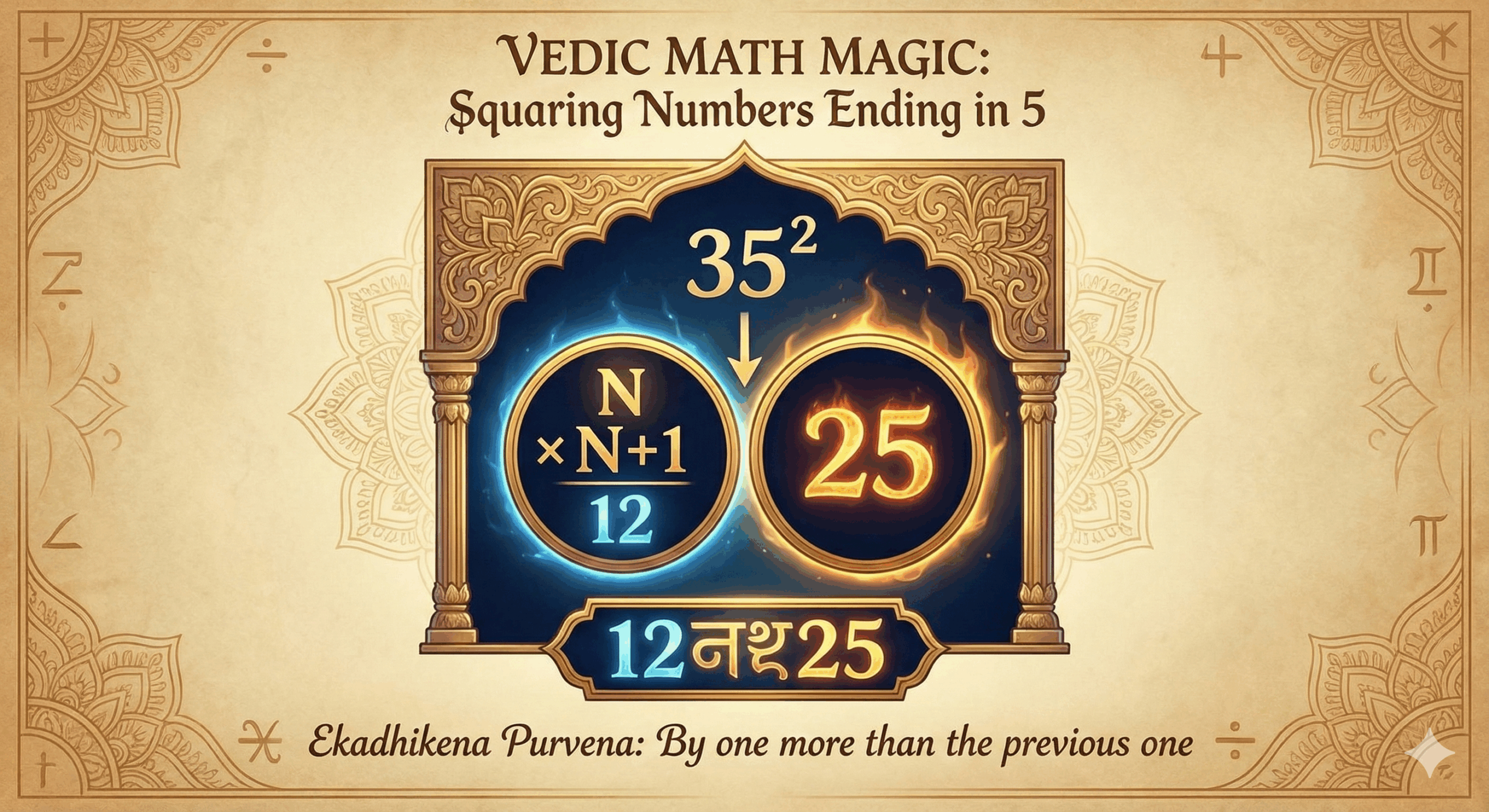
This ancient Indian system is known for its elegant sutras (aphorisms/formulas), and one of them, called **"Ekadhikena Purvena"** (meaning "By one more than the previous one"), is perfect for squaring numbers that end in the digit 5.
🔢 The Simple Rule: Ekadhikena Purvena
The technique breaks the problem down into two easy parts:
- The End Part: The last two digits of the answer will always be 25. (Since 5 × 5 = 25).
- The Front Part: Take the digit(s) that comes before the 5 (let's call this number N). Multiply N by the number that is one more than N (i.e., N + 1).
The result of the "Front Part" is placed in front of the "End Part" (25) to give you the final answer!
📝 Step-by-Step Examples
Example 1: Find 35²
- Identify N: The number before the 5 is 3. So, N = 3.
- Find N+1: 3 + 1 = 4.
- Calculate the Front Part: 3 × 4 = 12.
- Combine: Place the Front Part (12) before the End Part (25). 35² = 1225
Example 2: Find 85²
- Identify N: The number before the 5 is 8. So, N = 8.
- Find N+1: 8 + 1 = 9.
- Calculate the Front Part: 8 × 9 = 72.
- Combine: Place the Front Part (72) before the End Part (25). 85² = 7225
Example 3: Find 115²
- Identify N: The number before the 5 is 11. So, N = 11.
- Find N+1: 11 + 1 = 12.
- Calculate the Front Part: 11 × 12 = 132.
- Combine: Place the Front Part (132) before the End Part (25). 115² = 13225
💡 Why does this work? (The Math)
For the mathematically curious, this trick is just a clever simplification of algebra. Any number ending in 5 can be written as (10N + 5), where N is the preceding digit(s).
Squaring it gives: (10N + 5)^2 = 100N(N + 1) + 25. The (100N(N+1)term means you calculate (N(N+1)and shift it two decimal places to the left (by multiplying by 100), and then you simply add the 25. This proves that the result is always (N(N+1)) followed by 25. Neat, right?
🚀 Conclusion
Vedic Math isn't just a historical curiosity—it's a practical toolkit for fast mental calculations. Next time you see a number ending in 5, give the Ekadhikena Purvena method a try. You'll impress yourself and anyone watching!