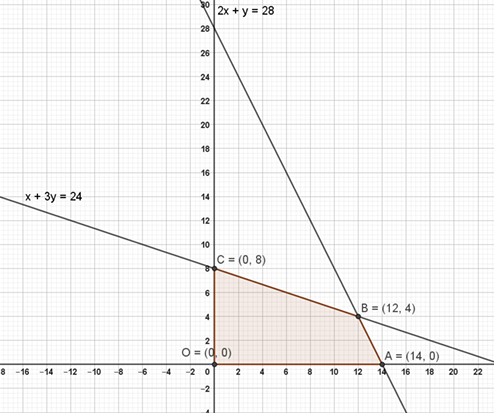
The graph illustrates the feasible region formed by the intersection of Machine Time and Craftsmanship constraints.
Step-by-Step Solution
Topic: Linear Programming Problems (LPP)
Step-by-Step Solution
Topic: Linear Programming Problems (LPP)
1. Define Variables & Data
Let x = Number of Cricket Bats.
Let y = Number of Tennis Rackets.
| Item | Machine Time (h) | Craft Time (h) | Profit (₹) |
|---|---|---|---|
| Bat (x) | 3 | 1 | 10 |
| Racket (y) | 1.5 | 3 | 20 |
| Max Available | 42 | 24 | – |
(I) TOTAL PROFIT EXPRESSION (Z)
Total Profit = (Profit per Bat × Bats) + (Profit per Racket × Rackets)
Z = 10x + 20y
(II) CRAFTSMANSHIP CONSTRAINT
Time for x bats = 1x hours.
Time for y rackets = 3y hours.
Total time available is 24 hours.
(III) MAXIMIZATION
Step 1: Write all constraints
- Machine: 3x + 1.5y ≤ 42 (Simplify by dividing by 1.5: 2x + y ≤ 28)
- Craft: x + 3y ≤ 24
- Non-negative: x ≥ 0, y ≥ 0
Step 2: Find Intersection Point
Multiply eq(ii) by 2: 2x + 6y = 48
Subtract eq(i) (2x + y = 28) from this: 5y = 20 ⇒ y = 4
Substitute y=4 in eq(ii): x + 12 = 24 ⇒ x = 12
Intersection Point = (12, 4)
Step 3: Corner Point Table
| Corner Point (x, y) | Value of Z = 10x + 20y |
|---|---|
| (0, 0) | 0 |
| (0, 8) | 10(0) + 20(8) = 160 |
| (14, 0) | 10(14) + 20(0) = 140 |
| (12, 4) | 10(12) + 20(4) = 120 + 80 = 200 |
⚠️ Silly Mistake Audit: Variable Assignment
Read the variable definition carefully!
The question text lists “tennis rackets” first in the description, but then defines “x” as the number of bats and “y” as the number of rackets.
A common mistake is assuming x = first item mentioned (rackets) and y = second item (bats). This would swap your coefficients in the Profit function and constraints, leading to a completely wrong answer.