Step-by-Step Solution
Topic: Application of Derivatives
(I) AREA FUNCTION A(x)
From the ellipse equation x2/a2 + y2/b2 = 1:
y2/b2 = 1 – x2/a2 = (a2 – x2)/a2
Taking square root: y = (b/a)√(a2 – x2)
Area of Rectangle:
Area = Length × Breadth = (2x)(2y) = 4xy
Substitute value of y:
(II) CRITICAL POINT
To make differentiation easier, let us maximize Z = [A(x)]2.
Z = 16x2 (b2/a2) (a2 – x2)
Z = (16b2/a2) (a2x2 – x4)
Differentiate Z w.r.t x:
dZ/dx = (16b2/a2) (2a2x – 4x3)
Set derivative to zero:
2a2x – 4x3 = 0
2x(a2 – 2x2) = 0
Since x ≠ 0 (dimension cannot be zero), we get:
2x2 = a2 ⇒ x2 = a2/2
(III) MAXIMIZATION & DIMENSIONS
Check for Maxima (Second Derivative Test):
d2Z/dx2 = (16b2/a2) (2a2 – 12x2)
At x = a/√2 (so x2 = a2/2):
Value = K (2a2 – 12(a2/2)) = K (2a2 – 6a2) = -4Ka2
Since the result is negative, the area is MAXIMUM at this point.
Calculate Dimensions:
- Length (2x): 2(a/√2) = √2a
- Breadth (2y): First find y.
y = (b/a)√(a2 – a2/2) = (b/a)√(a2/2) = (b/a)(a/√2) = b/√2.
Breadth = 2y = 2(b/√2) = √2b
Visual Representation: Rectangle Inscribed in Ellipse
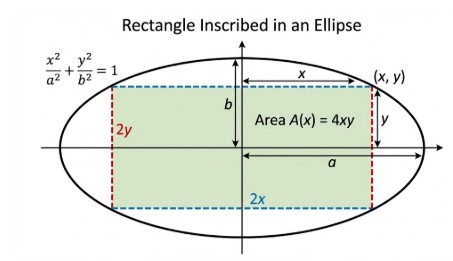
The diagram illustrates the inscribed rectangle with dimensions 2x (length) and 2y (breadth) inside the ellipse defined by x²/a² + y²/b² = 1.