Chapter 8: Application of Integrals
Area under Simple Curves & Between Two Curves
1. Area bounded by Curve and X-axis
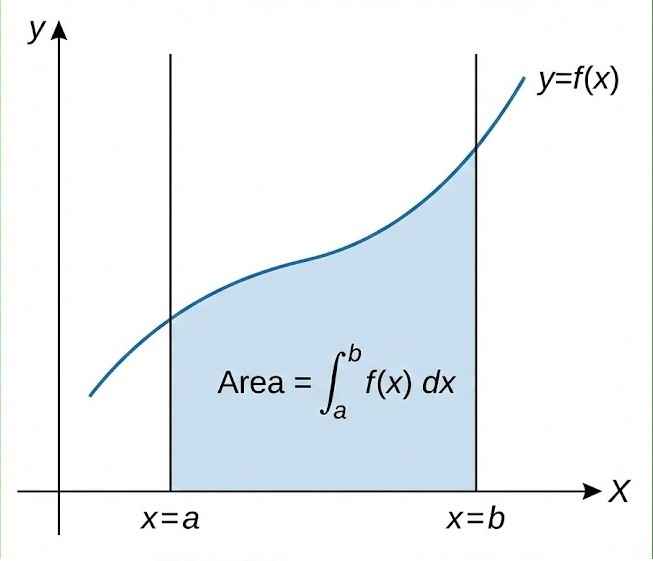
| Condition | Area bounded by curve $$y = f(x)$$, x-axis, and lines $$x = a, x = b$$. |
| Standard Formula | $$\text{Area} = \int_{a}^{b} y \, dx = \int_{a}^{b} f(x) \, dx$$ |
| If Curve is below X-axis | $$\text{Area} = \left| \int_{a}^{b} f(x) \, dx \right|$$ (Area is always positive) |
2. Area bounded by Curve and Y-axis
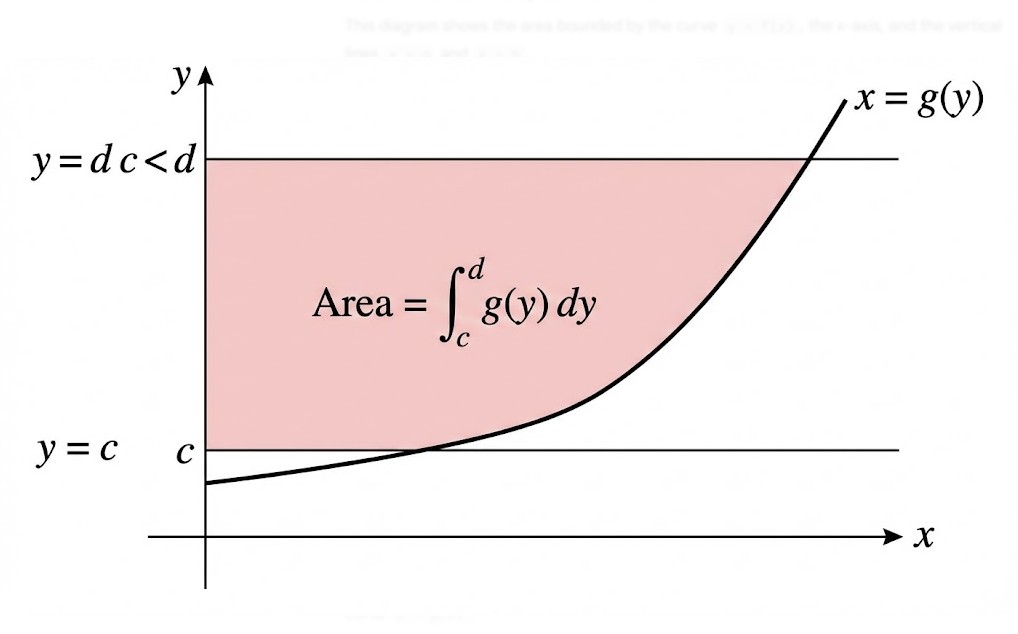
| Condition | Area bounded by curve $$x = g(y)$$, y-axis, and lines $$y = c, y = d$$. |
| Standard Formula | $$\text{Area} = \int_{c}^{d} x \, dy = \int_{c}^{d} g(y) \, dy$$ |
| Right vs Left of Y-axis | If area is to the left of Y-axis ($$x < 0$$), take the modulus $$|A|$$. |
3. Area bounded between Two Curves
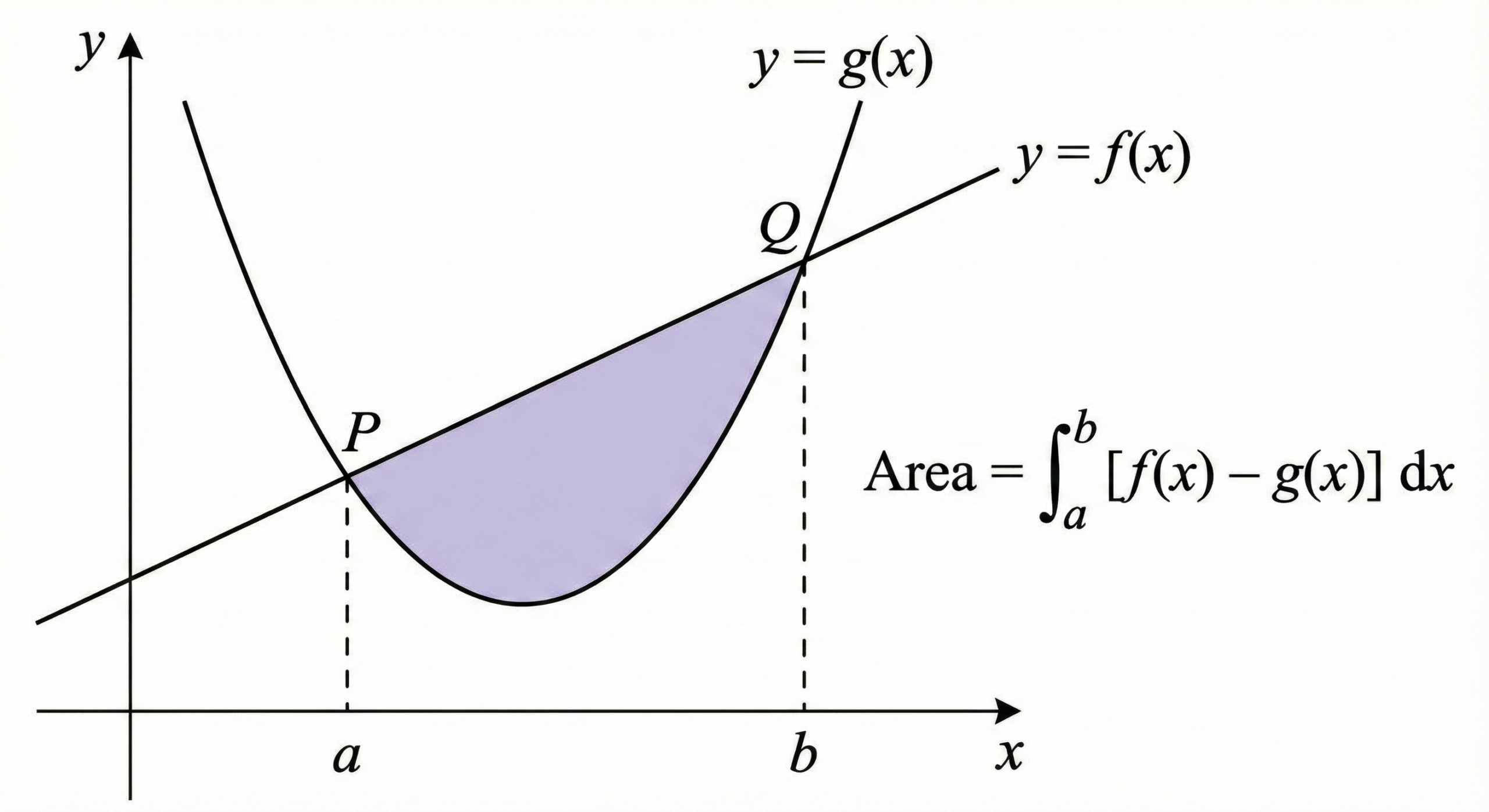
| Condition | Area enclosed between $$y = f(x)$$(Upper curve) and$$y = g(x)$$ (Lower curve). |
| Standard Formula | $$\text{Area} = \int_{a}^{b} [f(x) – g(x)] \, dx$$ |
| Finding Limits ($$a, b$$) | Solve $$f(x) = g(x)$$ to find the points of intersection. |
| Key Concept | $$\text{Required Area} = (\text{Area under Upper Curve}) – (\text{Area under Lower Curve})$$ |