Step-by-Step Solution
Topic: Rate of Change & Related Rates
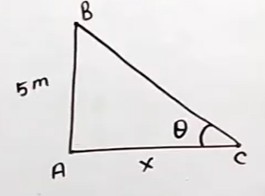
Diagram representing the pole (height 5m), the car’s distance (x), and the angle of elevation (θ).
Given Parameters
- • Height of pole (Opposite side) = 5 m
- • Distance of car (Adjacent side) = x m
- • Speed of car (dx/dt) = 20 m/s
- • Angle of elevation = θ
Note: Since the car is moving away, x is increasing, so dx/dt is positive.
(I) RELATION BETWEEN θ AND x
In the right-angled triangle formed by the pole, the ground, and the line of sight:
$$ \tan \theta = \frac{\text{Opposite}}{\text{Adjacent}} = \frac{5}{x} $$
(II) FIND dθ/dx
Differentiate θ with respect to x using the chain rule:
$$ \frac{d\theta}{dx} = \frac{d}{dx}\left(\tan^{-1}\left(\frac{5}{x}\right)\right) $$
$$ \frac{d\theta}{dx} = \frac{1}{1 + (\frac{5}{x})^2} \times \frac{d}{dx}\left(\frac{5}{x}\right) $$
$$ \frac{d\theta}{dx} = \frac{1}{1 + \frac{25}{x^2}} \times \left(-\frac{5}{x^2}\right) $$
Simplify the fraction:
$$ \frac{d\theta}{dx} = \frac{x^2}{x^2 + 25} \times \frac{-5}{x^2} $$
(III)(A) RATE OF CHANGE (dθ/dt) AT x = 50
Using the Chain Rule:
$$ \frac{d\theta}{dt} = \frac{d\theta}{dx} \times \frac{dx}{dt} $$
Substitute the formula from (ii) and given speed v = 20:
$$ \frac{d\theta}{dt} = \left(\frac{-5}{x^2 + 25}\right) \times 20 = \frac{-100}{x^2 + 25} $$
At x = 50 m:
$$ \frac{d\theta}{dt} = \frac{-100}{(50)^2 + 25} = \frac{-100}{2500 + 25} $$
$$ \frac{d\theta}{dt} = \frac{-100}{2525} = \frac{-4}{101} \text{ rad/s} $$
(III)(B) FIND SPEED GIVEN RATE 3/101
We are given the magnitude of rate of change: |dθ/dt| = 3/101 rad/s at x = 50 m.
Let speed be v.
$$ \left| \frac{d\theta}{dt} \right| = \left| \frac{-5}{x^2 + 25} \times v \right| $$
Substitute known values (x = 50):
$$ \frac{3}{101} = \frac{5}{2525} \times v $$
$$ \frac{3}{101} = \frac{1}{505} \times v $$
Solve for v:
$$ v = \frac{3 \times 505}{101} $$
Since 505 / 101 = 5:
$$ v = 3 \times 5 = 15 \text{ m/s} $$
⚠️ Silly Mistake Audit: The Chain Rule & Units
Don’t forget dx/dt!
A classic mistake in “Rate of Change” problems is finding the derivative with respect to position (dθ/dx) and forgetting to multiply by the velocity (dx/dt) to get the time derivative (dθ/dt). Always check if the question asks for “rate w.r.t distance” or “rate w.r.t time”.