Step-by-Step Solution
Topic: Inverse Trigonometric Functions
(I) ALTERNATIVE INTERVAL
The principal value branch is [-π/2, π/2].
Any interval where the sine function is one-one (monotonic) and covers the range [-1, 1] works.
Other intervals include:
- • [π/2, 3π/2]
- • [3π/2, 5π/2]
- • [-3π/2, -π/2]
(II) EVALUATE EXPRESSION
Expression: sin-1(-1/2) – sin-1(1)
Step 1: sin-1(-1/2)
Since sin(-π/6) = -1/2 and -π/6 ∈ [-π/2, π/2], the value is -π/6.
Step 2: sin-1(1)
Since sin(π/2) = 1 and π/2 ∈ [-π/2, π/2], the value is π/2.
Step 3: Subtract
(-π/6) – (π/2) = -π/6 – 3π/6 = -4π/6
(III)(A) GRAPH OF sin-1x
To draw the graph:
- • X-axis (Domain): from -1 to 1.
- • Y-axis (Range): from -π/2 to π/2.
- • Key Points: (-1, -π/2), (0, 0), (1, π/2).
The curve passes through origin with increasing slope.
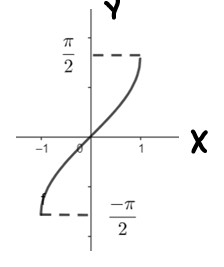
Graph of y = sin-1(x)
(III)(B) DOMAIN & RANGE OF f(x) = 2 sin-1(1 – x)
1. Find Domain:
The argument of sin-1 must be in [-1, 1].
-1 ≤ 1 – x ≤ 1
Subtract 1 from all sides: -2 ≤ -x ≤ 0
Multiply by -1 (inequality flips): 2 ≥ x ≥ 0
Domain: [0, 2]
2. Find Range:
We know that for the domain, sin-1(1 – x) lies in [-π/2, π/2].
Multiply the entire range by 2:
2 * [-π/2, π/2] = [-π, π]
Range: [-π, π]
Range: [-π, π]
⚠️ Silly Mistake Audit: Inequality Flipping
Watch the Negative Sign!
When solving the domain inequality -2 ≤ -x ≤ 0, a very common mistake is forgetting to flip the inequality signs when multiplying or dividing by a negative number.
Incorrect: -2 ≤ x ≤ 0 (This implies x is negative, which is wrong)
Correct: 2 ≥ x ≥ 0 (This implies x is between 0 and 2).