Step-by-Step Solution
Topic: Maxima & Minima
Visual Representation
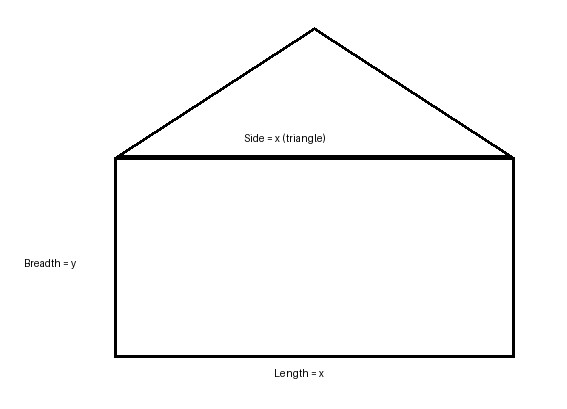
The window consists of a rectangle (dimensions x, y) surmounted by an equilateral triangle (side x).
(I) RELATION BETWEEN x AND y
The “Perimeter of the window” implies the outer boundary length.
Boundary = (Base) + (Left side) + (Right side) + (Two sides of the equilateral triangle).
Sides of equilateral triangle = x.
Perimeter (P) = x + y + y + x + x = 3x + 2y
Given P = 12m:
(II) AREA FUNCTION A(x)
Area = Area of Rectangle + Area of Equilateral Triangle.
Area = xy + (√3 / 4)x2
From (i), y = (12 – 3x) / 2
Substitute y into the Area equation:
A(x) = x [ (12 – 3x)/2 ] + (√3 / 4)x2
(III)(A) MAXIMIZING LIGHT (AREA)
Differentiate A(x) with respect to x:
A'(x) = 6 – 3x + (√3 / 2)x
For critical points, set A'(x) = 0:
6 – x(3 – √3/2) = 0
6 = x( (6 – √3) / 2 )
x = 12 / (6 – √3)
(III)(B) PERIMETER EXPRESSION GIVEN AREA = 50
Step 1: Use Area condition to find y
Given Area = 50 m2
Area = xy + (√3 / 4)x2 = 50
xy = 50 – (√3 / 4)x2
y = (50/x) – (√3 / 4)x
Step 2: Substitute y into Perimeter formula
Perimeter P = 3x + 2y
P(x) = 3x + 2 [ (50/x) – (√3 / 4)x ]
P(x) = 3x + (100/x) – (√3 / 2)x
Combine x terms: